
The Pitfalls of Ignorance: How the Dunning-Kruger Effect Can Sabotage Your Learning Journey
In short: The Dunning-Kruger effect describes the tendency of incompetent individuals to overestimate their abilities, and competent individuals to underestimate theirs. In this article, you will learn the psychological background of this bias and receive concrete strategies to recognize, overcome, and sustainably improve your learning processes and personal development.
Have you ever wondered why some people with little experience appear so confident, while true experts often seem more modest? Or have you ever started a new topic and, after a short time, thought, 'I've totally got this!' – only to later realize you were still at the very beginning? If so, you've encountered the Dunning-Kruger effect, a fascinating cognitive bias that significantly influences our learning and self-assessment.
1. What is the Dunning-Kruger Effect? A Psychological Explanation
The Dunning-Kruger effect is a cognitive bias described in 1999 by psychologists David Dunning and Justin Kruger of Cornell University in their seminal study “Unskilled and Unaware of It: How Difficulties in Recognizing One's Own Incompetence Lead to Inflated Self-Assessments”. They found that people with low ability in a particular area tend to greatly overestimate their competence. Simultaneously, highly competent individuals often underestimate their own abilities, mistakenly assuming that others possess the same knowledge or skills.
The core of the problem lies in the fact that incompetence often prevents one from recognizing one's own incompetence. To know how much you don't know, you must already possess a certain level of knowledge or meta-cognition. It's like a blind spot: you can't see it yourself unless someone points it out to you.
Important Note: The Dunning-Kruger effect is not a sign of stupidity, but a natural human tendency. Anyone can be affected by it, especially when venturing into a new field.
2. The Curve of Competence: Phases of the Dunning-Kruger Effect
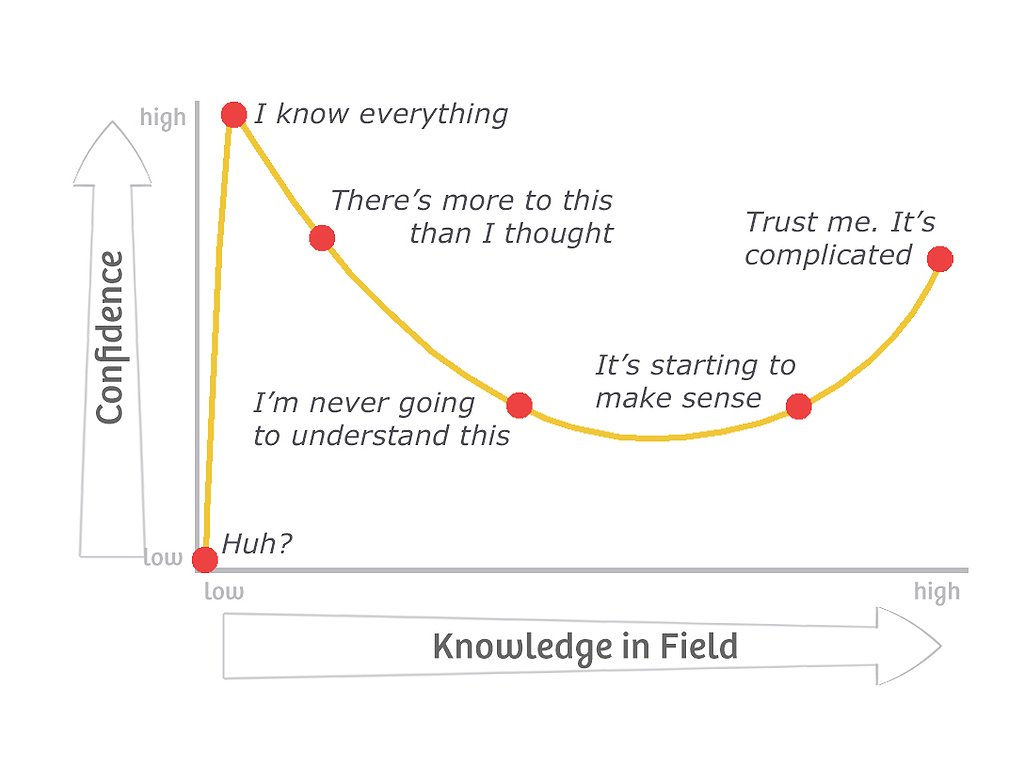
The Dunning-Kruger effect is often illustrated by a graph showing the relationship between actual competence and perceived confidence. Typical phases can be identified:
- The Peak of Mount Stupid: This is the point where beginners with little knowledge and experience have extremely high confidence. They've learned just enough to grasp basic concepts and already feel like experts.
- The Valley of Despair: As beginners learn more, they realize how complex the subject truly is and how little they actually know. Their confidence plummets, and they often feel frustrated and discouraged.
- The Slope of Enlightenment: With continuous learning and practice, actual competence slowly increases again, and confidence begins to become more realistic.
- The Plateau of Sustainability: At this level, people are truly competent and have a realistic understanding of their abilities. They know what they know, and also what they don't know. Experts here are often more modest, as they fully grasp the depth and breadth of their field.
3. Why We Overestimate Ourselves: The Psychology Behind It
3.1. Lack of Meta-Cognition
The primary reason for the Dunning-Kruger effect is a lack of meta-cognition – the ability to think about one's own thinking. To judge the quality of your performance, you must possess the knowledge of what constitutes good performance. If you lack this knowledge, you cannot recognize your own incompetence.
3.2. Confirmation Bias
People tend to interpret information in a way that confirms their existing beliefs. If you believe you are good at something, you unconsciously seek evidence that supports this and ignore contradictory information.
3.3. Wishful Thinking and Self-Esteem Protection
Sometimes we overestimate ourselves because it feels good. An inflated self-image can protect against the unpleasant feelings of incompetence. This is a form of self-esteem protection.
3.4. Unrealistic Comparisons
Beginners often compare themselves to other beginners or to their own former, less knowledgeable selves, rather than to true experts. This leads to a distorted perception of their own progress.
4. Avoiding the Dunning-Kruger Effect: Practical Strategies for Your Learning Journey
Fortunately, you are not helpless against the Dunning-Kruger effect. Here are concrete steps you can take to recognize and overcome it:
4.1. Actively Seek Feedback
One of the most effective ways to eliminate your blind spot is to seek honest feedback from others. Ask mentors, teachers, or colleagues for their opinion on your performance. Be open to constructive criticism and view it as an opportunity for growth.
4.2. Learn from Experts
Spend time with people who are truly competent in the area you want to learn. Observe their working methods, ask questions, and try to understand their ways of thinking. This helps you get a realistic picture of what true expertise means.
4.3. Objectively Test Your Knowledge
Don't just rely on your gut feeling. Take tests, solve practical problems, or apply your knowledge in real-world projects. Objective performance indicators are an incorruptible measure of your actual abilities.
4.4. Regularly Reflect on Your Progress
Consciously take time to reflect on your learning. What have you truly learned? Where are you still struggling? A learning journal or regular self-reflection exercises can help develop a more realistic self-assessment.
4.5. Surround Yourself with Learning Partners and Mentors
Exchanging ideas with other learners can be extremely valuable. A learning partner can challenge you, offer a different perspective, and point out mistakes you wouldn't see yourself. A mentor can guide you and help you better assess the complexity of a topic.
Practical Block: Your Anti-Dunning-Kruger Action Plan
To actively combat the Dunning-Kruger effect, implement the following steps:
- Choose a Learning Goal: Identify a new skill or topic you want to learn (e.g., a new language, programming, a musical instrument).
- Set SMART Goals: Define specific, measurable, achievable, relevant, and time-bound goals for the first few weeks.
- Seek Feedback Sources: Identify at least two people or methods to receive objective feedback (e.g., a language teacher, a code review from a colleague, online quizzes, a mentor).
- Keep a Learning Journal: Weekly record what you've learned, where you've struggled, and how you assess your progress. Compare your assessment with the feedback received.
- Find a Learning Partner: Use platforms like Skill Tandem to find someone who is learning the same thing or can support you in your learning process. Discuss your progress and challenges together.
Conclusion: Humility as the Key to Mastery
The Dunning-Kruger effect is a powerful reminder that our self-perception can often be deceptive, especially at the beginning of a learning journey. True mastery doesn't start with exaggerated self-confidence, but with the humility to recognize how much there is still to learn. By actively seeking feedback, objectively testing your knowledge, and surrounding yourself with a supportive learning community, you can circumvent the pitfalls of overestimation and embark on a realistic, effective path to genuine competence.
The journey from novice to expert is long and full of challenges. But with the right attitude and strategies, you can ensure you're on the right track. And this is precisely where Skill Tandem can help you. Our free platform connects you with learning partners and mentors who will support you on your journey. Learning together is not only more effective but also more motivating – and you receive valuable external feedback that leaves no room for the Dunning-Kruger effect.
Sign up for free and find a learning partner now!
FAQ: Frequently Asked Questions about the Dunning-Kruger Effect
What is the Dunning-Kruger effect explained simply?
The Dunning-Kruger effect describes that people with limited knowledge in an area often tend to overestimate their abilities, while experts underestimate their competence. It is a cognitive bias that arises from a lack of meta-cognition.
Is the Dunning-Kruger effect scientifically proven?
Yes, the Dunning-Kruger effect was described in 1999 by psychologists David Dunning and Justin Kruger in a widely cited study and has since been confirmed in numerous other research papers. It is a recognized effect in psychology.
How does the Dunning-Kruger effect manifest in everyday life?
In everyday life, the effect manifests when someone with little experience finds a task very simple and feels extremely confident, or when a layperson dismisses an expert opinion because they believe they know better. The phenomenon of experts downplaying their abilities is also a manifestation.
How can I recognize the Dunning-Kruger effect in myself?
You can recognize it by actively seeking feedback, objectively testing your knowledge (e.g., through exams or practical applications), and regularly comparing your self-assessment with external evaluations. If your subjective assessment deviates significantly from objective results, the effect might be at play.
Can the Dunning-Kruger effect also have positive aspects?
Sometimes, an initial, exaggerated self-confidence can lead one to start something new and overcome initial hurdles that they might not have tackled with a more realistic assessment. However, it's crucial to quickly replace this initial optimism with realistic evaluation and continuous learning.



Das mit dem Überschätzen bei Anfängern kenn ich! Mich würde noch interessieren, ob das auch bei sehr erfahrenen Leuten passieren kann, nur in anderen Bereichen.