
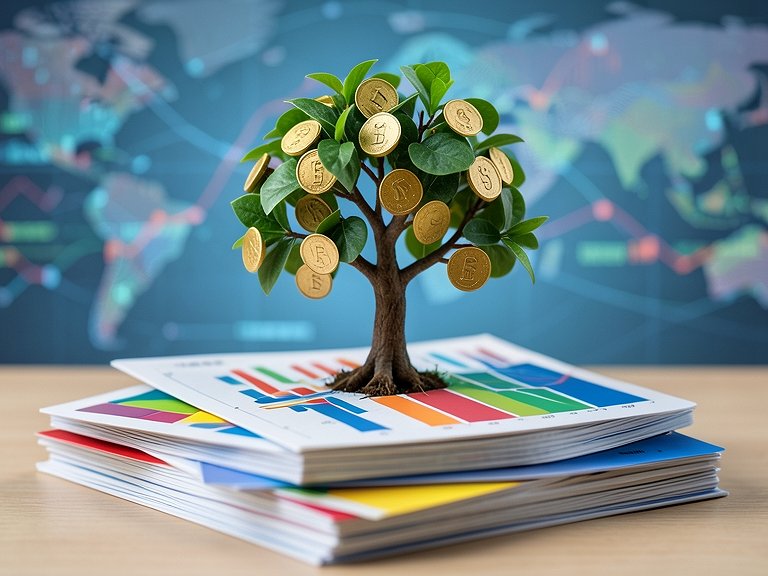
ETFs for Beginners: Your Guide to the Financial World in 2026
In short: ETFs (Exchange Traded Funds) will remain one of the best and most accessible investment options for beginners in 2026. The most significant changes involve an increasing specialization of ETFs (e.g., focusing on ESG criteria or specific megatrends) and greater digitalization of the investment process. In this article, you'll learn how ETFs work, which trends are relevant in 2026, and how to develop a successful ETF strategy for building wealth and achieving financial independence.
1. What are ETFs and why are they so popular?
ETFs are exchange-traded index funds that track the performance of a specific index (e.g., DAX, S&P 500, MSCI World). Instead of buying individual stocks, you invest in a variety of companies included in that index with a single ETF. This makes them an ideal tool for investors who want to invest broadly diversified and cost-effectively, without constantly having to worry about individual companies.
Important Tip: The biggest advantage of ETFs lies in their ease of use and low costs compared to actively managed funds. You benefit from market development without having to pay expensive fund managers.
1.1. The Basic Principles of ETFs
- Diversification: By tracking an index, you automatically spread your risk across many companies and industries.
- Cost-efficiency: ETFs generally have significantly lower management fees (TER – Total Expense Ratio) than actively managed funds.
- Flexibility: You can buy and sell ETFs anytime during trading hours, just like individual stocks.
- Transparency: The composition of an ETF is transparent at all times, as it tracks a known index.
2. The Most Important ETF Trends for 2025/2026
The world of ETFs is constantly evolving. For 2025 and 2026, several clear trends are emerging that you should be aware of as a beginner to future-proof your investment strategy.
2.1. Sustainable ETFs (ESG) on the Rise
Sustainability is no longer a niche topic but a central factor for many investors. ESG ETFs (Environmental, Social, Governance) invest in companies that meet specific criteria regarding environment, social issues, and corporate governance. This trend will intensify in 2025/2026, as more and more investors seek not only financial but also ethical returns.
Practical Advice: When choosing ESG ETFs, pay close attention to the selection criteria of the respective fund. Not every 'green' ETF is equally 'green'. Compare the underlying indices and their filtering mechanisms.
2.2. Megatrend ETFs and Thematic Investments
In addition to broad market indices, ETFs that invest in specific future trends are gaining importance. These include topics such as artificial intelligence, renewable energy, robotics, cybersecurity, or hydrogen technology. These thematic ETFs allow you to participate specifically in growth industries. However, be aware that such specialized ETFs can often carry higher risk than broadly diversified global ETFs.
2.3. The Role of Crypto ETFs and Digitalization
The cryptocurrency market continues to mature, and with it, the opportunities to invest in it. While direct investments in individual cryptocurrencies like Bitcoin or Ethereum remain volatile, crypto ETFs (or ETPs – Exchange Traded Products) are gaining importance. They offer a regulated and often simpler way to participate in the price development of cryptocurrencies without having to manage wallets yourself. The general digitalization of the investment process is also progressing, with increasingly intuitive apps and platforms.
3. Your Step-by-Step Guide to Starting with ETFs in 2026
Practical Block: Your Roadmap to Your First ETF Investment
Getting started in the world of ETFs is easier than you might think. Here's a concrete plan on how to proceed:
- Step 1: Define Financial Goals: Consider what you want to save for (e.g., retirement, home, world trip) and what your investment horizon is (short, medium, or long-term).
- Step 2: Assess Risk Tolerance: How much fluctuation are you willing to tolerate? A broadly diversified global ETF is usually less risky than a specialized thematic ETF. Be honest with yourself.
- Step 3: Open a Brokerage Account: Choose an online broker that offers favorable conditions for ETF savings plans. Compare fees, product range, and user-friendliness. Many direct banks offer free account management.
- Step 4: Select the Right ETF: For beginners, a globally diversified ETF tracking the MSCI World or FTSE All-World index is often recommended. Look for a low TER (Total Expense Ratio) and sufficient fund size.
- Step 5: Set Up a Savings Plan: Set up a monthly savings plan. Even small amounts (e.g., 25€ or 50€ per month) can grow into a significant fortune over time through the compound interest effect. Automation is key to success here!
- Step 6: Review and Adjust Regularly: You should review your ETF investments at least once a year. Do they still align with your goals and risk tolerance? You might want to rebalance or add additional ETFs.
Remember that patience and discipline are key to successful ETF investing. Don't be discouraged by short-term market fluctuations.
Conclusion: ETFs Remain a Cornerstone for Your Wealth Building
ETFs are and will remain an excellent way for beginners to participate in the growth of the global economy simply and cost-effectively. The trends for 2025/2026 show increasing specialization and digitalization, offering you even more options to align your investments with your values and goals. Start your ETF savings plan today and lay the foundation for your financial future!
If you want to delve deeper into the subject or are looking for individual support in building wealth, you can find experienced financial mentors on Skill Tandem (skilltandem.app) who will assist you with advice and support. Our platform is completely free and offers you the opportunity to benefit from real expert knowledge.
FAQ: Frequently Asked Questions about ETFs for Beginners 2026
What is the best ETF for beginners in 2026?
For beginners, a broadly diversified global ETF that tracks indices like the MSCI World or FTSE All-World is often the best choice. It offers global diversification and a balanced risk-return profile.
How much money do I need to invest in ETFs?
You can start investing in ETFs with very small amounts. Many brokers offer ETF savings plans starting from 25 Euros per month, making it very accessible.
Are ETFs safe, or can I lose all my money?
ETFs are special assets and are protected in case of insolvency of the provider. The risk lies in the performance of the underlying markets. A total loss is unlikely with broadly diversified ETFs, but price fluctuations are normal and part of investing.
Should I invest in sustainable (ESG) ETFs in 2026?
If sustainability is important to you and you want to invest your money ethically, ESG ETFs are a good option. They allow you to invest in companies that meet specific environmental, social, and governance criteria.
What is the difference between an ETF and a regular mutual fund?
The main difference lies in management and costs. ETFs passively track an index and are therefore more cost-effective. Regular mutual funds are actively managed by fund managers, which incurs higher fees and doesn't guarantee outperforming the market.

Finde den Aufbau echt super klar, da blickt man gleich viel besser durch! 👍
"Hallo Sarah, freut mich total, dass dir der Aufbau gefaellt! Mir ging es frueher auch oft so, dass ich mich in unuebersichtlichen Texten verloren habe.\