
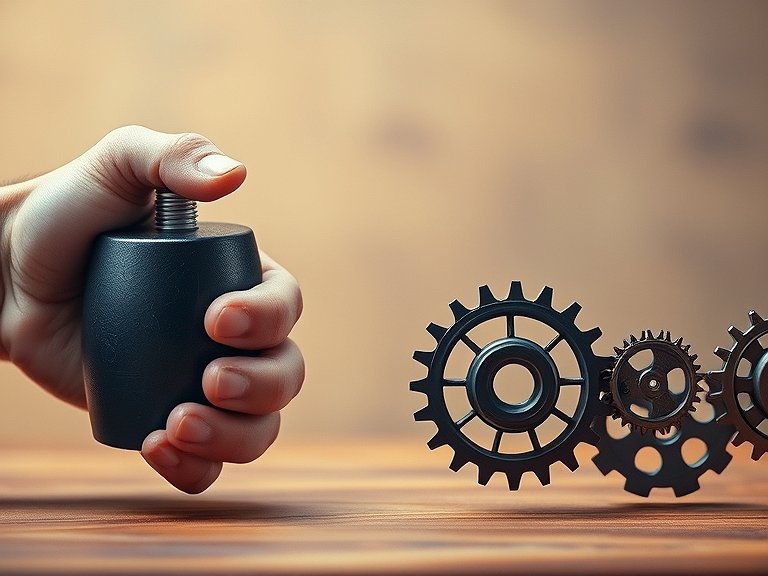
Is Pure Willpower the Key to Habit Change? Debunking a Common Myth!
In short: No, pure willpower is rarely sufficient and often even counterproductive when it comes to permanently changing habits. In this article, you'll learn why this is the case, what factors truly matter, and how to achieve your goals using proven strategies and a supportive environment.
Have you ever wondered why it's so hard to break bad habits or establish good ones, even when you're determined? Many of us believe it's simply a lack of willpower. We resolve to eat fewer sweets, exercise more, or wake up earlier, only to fail repeatedly. The common belief is that we're just not disciplined enough. But this view is not only simplistic but also misleading and demotivating.
The truth is more complex. Willpower is like a muscle: it's finite and gets tired with overuse. Relying solely on it is a recipe for frustration. Instead, our environment, the structure of our routines, and our deeper understanding of the psychology behind habits play a much larger role. Let's debunk this myth and discover how you can truly make lasting changes in your life.
1. The Myth of Infinite Willpower: Why It Sabotages You
Many coaches and self-help gurus preach the power of willpower. 'You just have to really want it!' is a common refrain. While this may be true in some moments, as a long-term strategy for habit change, it's fatal. Research, especially from psychology, shows that our willpower is limited. Every day, every decision, and every resistance to temptation depletes this reserve.
Imagine you've had a demanding workday, made difficult decisions, and are completely exhausted by evening. Is it realistic to expect yourself to still summon the 'willpower' to go to the gym instead of collapsing on the couch? Probably not. Your 'willpower tank' is empty. The problem isn't your character or discipline, but the strategy you're pursuing.
Important Note: Judging yourself for a lack of willpower is counterproductive. It leads to guilt and demotivation. Understand that it's a natural process, and instead, focus on systemic solutions.
2. The True Power: Shaping Your Environment and Routines
If willpower isn't the main actor, what is? This is where your environment and the design of your routines come into play. Experts like James Clear in 'Atomic Habits' emphasize that habits don't form in a vacuum. They are responses to cues in our environment.
2.1. Your Environment as the Invisible Architect of Your Habits
Your home, your workplace, the people you surround yourself with – all of this massively influences your habits. Do you want to eat healthier? Then remove sweets from plain sight and place fruit on the kitchen table instead. Do you want to read more? Place a book by your bed and your phone out of reach. Do you want to wake up earlier? Lay out your workout clothes the night before.
It's about designing your environment so that desired habits become easy and undesired ones become difficult. This requires some effort initially but greatly relieves your willpower, as you have fewer decisions to make.
2.2. The Power of Small Steps and 'Habit Stacking'
Instead of aiming for big changes all at once, focus on tiny, incremental steps. Do you want to go for a run? Start by just putting on your running shoes. Do you want to meditate? Start with one minute. These small actions lower the barrier and make starting easier.
Another effective technique is 'habit stacking.' Attach a new habit to an existing one. For example: 'After I drink my morning coffee, I will meditate for 5 minutes.' Or: 'After I brush my teeth, I will do 10 push-ups.' This leverages the inertia of existing routines, making it easier to integrate new ones.
3. Understanding the Psychology Behind Habits: Cue, Routine, Reward
Every habit follows a loop: Cue → Routine → Reward. This model was popularized by Charles Duhigg in 'The Power of Habit'.
- Cue: A trigger that starts the habit (e.g., the sight of chips, boredom, a specific time).
- Routine: The actual action (e.g., eating chips, reaching for your phone, going to the gym).
- Reward: The positive feeling or benefit you get from the action (e.g., taste, distraction, feeling of strength).
To change a bad habit, you often need to identify the cue and adjust the routine or the reward. If boredom is the cue for scrolling social media, you could read a book or call a friend instead – thus receiving a different reward (learning, social interaction).
Practical Block: Your Habit Audit and Action Plan
Take some time to analyze your current habits and create a plan that spares your willpower.
- Identify a habit you want to change: Is it something you want to build (e.g., drink more water) or eliminate (e.g., snacking in the evening)?
- Recognize the cue: What triggers this habit? (Time, place, feeling, other people?)
- Analyze the routine: What exactly do you do?
- Define the reward: What need is being satisfied by this? (Relaxation, distraction, pleasure?)
- Design your environment: How can you create physical barriers for bad habits and place supporters for good habits? (e.g., put away sweets, lay out workout clothes.)
- Apply habit stacking: What existing habit can you use to attach a new, desired habit?
- Plan small steps: What is the absolute smallest version of the new habit you can implement immediately?
Conclusion: Less Willpower, More System
The belief that willpower is everything when it comes to habit change is a persistent myth. While a certain level of determination is necessary, shaping your environment, understanding the habit loop, and applying strategies like habit stacking are far more effective for sustainable changes. Focus on optimizing your system rather than constantly relying on an exhaustible resource. You are not lazy or undisciplined; you may have simply been following the wrong strategy.
On Skill Tandem (skilltandem.app/en), you can find like-minded individuals who want to build or change similar habits. Together, you can motivate each other, share experiences, and hold each other accountable. It's a completely free platform that helps you achieve your goals. Sign up for free and build new habits together!
FAQ: Frequently Asked Questions about Habit Change
Is it true that willpower is limited?
Yes, psychological studies show that willpower is a finite resource that gets depleted throughout the day by every conscious decision and effort. This phenomenon is often referred to as 'ego depletion.'
How long does it take to establish a new habit?
The popular assumption of 21 days is a myth. Studies vary, but it can take anywhere from 18 days to 254 days for a new habit to become automated. More important than the exact duration is the consistency of execution.
Can I change multiple habits at once?
It's often more effective to focus on one or two habits at a time. If you try to change too many things at once, you'll overwhelm your willpower and increase the risk of failure. Small, focused steps are more sustainable.
What should I do if I experience a setback?
Setbacks are normal and part of the process. The important thing is not to get discouraged. Analyze what went wrong, adjust your strategy, and restart immediately. A single interruption doesn't destroy all your progress.
Does motivation play no role in habit change?
Motivation is important to get started. But for long-term maintenance, systems and routines are more crucial than pure motivation, which often fluctuates. Build systems that keep you going even when motivation wanes.




Ich frag mich aber, ob ein gewisses Maß an Willenskraft nicht doch am Anfang nötig ist, um überhaupt ins Rollen zu kommen. Irgendwie muss man den ersten Schritt ja machen, oder nicht 🤔