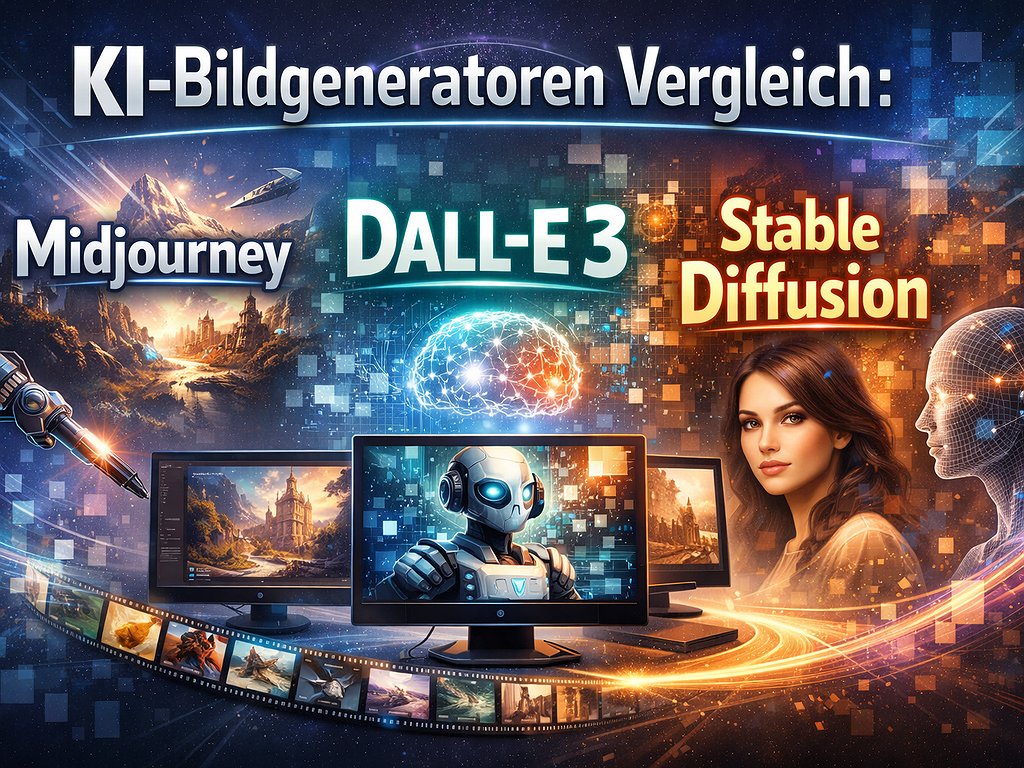
Are you facing the choice of the right AI image generator and unsure which one best matches your creative vision?
In short: The best AI image generator largely depends on your specific needs. Midjourney excels with aesthetically stunning images and ease of use, DALL-E 3 (integrated into ChatGPT Plus/Copilot) offers unmatched prompt understanding and text integration, while Stable Diffusion provides maximum control and customizability for tech-savvy users. In this article, you'll learn the exact differences to make an informed decision on which tool will elevate your creative projects.
1. Why AI Image Generators Are Revolutionizing the Creative World
Artificial intelligence has fundamentally changed how we create and interact with images. What was science fiction just a few years ago is now reality: with simple text descriptions, we can generate impressive visual content within seconds. This opens new horizons not only for professional designers and artists but also for hobbyists, marketers, and content creators. The challenge, however, is to select the right tool from the abundance of available options that best suits one's own requirements. Three names currently dominate the discussion: Midjourney, DALL-E 3, and Stable Diffusion.
Important Tip: Before committing to a tool, consider what kind of images you'll most frequently create. Are you aiming for photorealistic depictions, artistic concepts, logos, or perhaps the visualization of text content? Your use cases are crucial!
2. The Candidates in Detail: Features and Specifics
2.1. Midjourney: The Aesthete for Impressive Images
Midjourney is known for its ability to generate extremely aesthetic and often surreal or artistic images. It has quickly become a favorite for artists and designers who value a distinctive style.
- User Interface: Primarily via Discord. This takes some getting used to but offers a vibrant community and quick updates.
- Image Quality: Excellent, often with a painterly or cinematic look. Particularly strong with imaginative, abstract, and atmospheric images.
- Prompt Understanding: Good, but often requires some practice to achieve desired results. Less precise with complex text instructions than DALL-E 3.
- Special Features: Strong upscaling, image variations, inpainting/outpainting (limited), style references.
2.2. DALL-E 3 (via ChatGPT Plus/Copilot): The Language Comprehender
DALL-E 3, developed by OpenAI, is renowned for its excellent understanding of natural language. It is seamlessly integrated into ChatGPT Plus and Microsoft Copilot, making interaction extremely intuitive.
- User Interface: Via the chat interface of ChatGPT or Copilot. Extremely user-friendly, as you simply express your wishes in a conversational style.
- Image Quality: Very good, especially in depicting objects, scenes, and text with high detail. It understands complex instructions and can better maintain consistent characters/styles across multiple images.
- Prompt Understanding: Unmatched. DALL-E 3 interprets even long and detailed prompts very accurately and can even derive image ideas from a conversational context.
- Special Features: Excellent text integration in images, context-based prompting, rapid iterations.
2.3. Stable Diffusion: The Open-Source Powerhouse for Control
Stable Diffusion is an open-source model that offers maximum flexibility and control. It can be run locally on your own computer (if the hardware allows) or used via various web interfaces and APIs.
- User Interface: Varies greatly. From simple online tools to complex local installations like Automatic1111's Web UI. Requires technical understanding.
- Image Quality: Very good; can match or exceed others if parameters are set correctly. Quality is highly dependent on the model (checkpoint) used and the settings.
- Prompt Understanding: Good, but often requires more specific prompting techniques and an understanding of negative prompts to avoid unwanted elements.
- Special Features: Infinite customization options through various models (checkpoints), LoRAs, ControlNet for precise poses/compositions, inpainting/outpainting, image-to-image generation.
3. Pros and Cons in Direct Comparison
3.1. Midjourney:
- Pros:
- Outstanding aesthetic quality and unique style.
- Easy entry for artistically appealing results.
- Strong, helpful community on Discord.
- Cons:
- Discord-based interface isn't for everyone.
- Less precise control over details and image composition.
- Weaker text integration within images.
- Hardly any free trial, subscription model.
3.2. DALL-E 3:
- Pros:
- Excellent prompt understanding and natural language interaction.
- Great for complex scenes and text integration.
- Very user-friendly due to integration into ChatGPT/Copilot.
- Can learn and iterate from conversational contexts.
- Cons:
- Less artistically aesthetic than Midjourney (often more 'clean' and 'generic').
- Less direct control over parameters than Stable Diffusion.
- Subscription model (ChatGPT Plus) or usage via Copilot.
3.3. Stable Diffusion:
- Pros:
- Maximum control and customizability (open source).
- Countless models and extensions for specific styles and tasks.
- Can be run locally (data privacy, no dependence on cloud services).
- Free in its basic version when run locally.
- Cons:
- High barrier to entry, requires technical knowledge.
- Needs powerful hardware for local execution.
- Quality heavily dependent on model choice and prompt engineering.
- Web interfaces can be overwhelming.
4. Costs: Free vs. Paid
The pricing models of AI image generators vary significantly and are an important factor in decision-making.
- Midjourney: No longer offers a free trial. There are various subscription tiers, starting at approximately 10 USD per month for a limited number of GPU minutes. Higher subscriptions are needed for intensive use.
- DALL-E 3: Not available directly as a standalone product. You gain access through a ChatGPT Plus subscription (approx. 20 USD per month) or for free via Microsoft Copilot (with limitations).
- Stable Diffusion: The core model is open source and thus free if you run it locally on your own hardware. However, there are also numerous commercial services and APIs that use Stable Diffusion and charge fees (e.g., DreamStudio by Stability AI).
Practice Block: Your First AI Image Generator Prompt
No matter which tool you choose, the quality of your prompts is crucial. Here's a quick guide on how to write better prompts:
- Be Specific: Instead of 'a dog,' try 'a golden retriever puppy playing in a meadow, in the style of an oil painting.'
- Use Adjectives: Describe colors, moods, materials, lighting (e.g., 'vibrant,' 'dark,' 'shiny,' 'rustic,' 'futuristic').
- Give Style Instructions: 'Photorealistic,' 'anime style,' 'Van Gogh,' 'cyberpunk,' 'minimalist,' '3D render.'
- Define Composition: 'Close-up,' 'wide shot,' 'from above,' 'portrait,' 'landscape.'
- Experiment with Negative Prompts (especially with Stable Diffusion): What do you NOT want to see? (e.g., 'poorly drawn, blurry, text, watermark').
Example Prompt: 'A majestic lion with a fiery mane standing on a rock at sunset, epic wide-angle shot, golden hour, photorealistic, Ultra-HD, Cinematic Lighting.'
5. Who is Each Tool Best Suited For?
- Midjourney:
- For: Artists, designers, illustrators looking for unique, aesthetically pleasing images with a distinctive style. Ideal for concept art, fantasy illustrations, abstract works.
- Not for: Users seeking pixel-perfect control, precise text integration, or a completely free solution.
- DALL-E 3:
- For: Content creators, marketers, writers who need to quickly and easily create precise images from complex text descriptions. Excellent for blog images, social media posts, visualizing ideas, or creating images with specific text.
- Not for: Users who want full control over every detail of the generation process or are looking for a very specific, artistic style beyond the standard repertoire.
- Stable Diffusion:
- For: Tech-savvy artists, developers, researchers who value maximum control, customizability, and the ability to run locally. Perfect for advanced applications, experiments, developing custom models, or integrating into existing workflows.
- Not for: Beginners without technical understanding or users looking for a simple, ready-to-use solution without configuration effort.
Conclusion: Your Personal AI Image Generator Champion
The choice of the 'best' AI image generator is subjective and depends on your priorities. If you value aesthetic brilliance and ease of use, Midjourney is an excellent choice. If you're looking for precise prompt understanding and seamless text integration, then DALL-E 3 (via ChatGPT Plus/Copilot) is your tool. If maximum control, customizability, and open source are important to you, you should explore Stable Diffusion.
Each of these tools has its strengths and weaknesses. The best approach is to try out the accessible versions and find out which one feels most intuitive and delivers the results you envision. And remember: the world of AI is evolving rapidly. What's best today might be surpassed tomorrow!
Don't want to explore the world of AI image generators alone? On Skill Tandem (skilltandem.app), you can find free learning partners who are also diving into AI image generation or are already experts. Exchange ideas, learn together, and master prompts side-by-side! Sign up for free and find your learning partner!
FAQ: Frequently Asked Questions about AI Image Generators
Is Midjourney better than DALL-E 3?
Whether Midjourney is better than DALL-E 3 depends on individual preferences. Midjourney is often more aesthetic and artistic, while DALL-E 3 better understands complex instructions and text integration. For quick, precise, and text-based visualizations, DALL-E 3 is often superior; for artistic concepts, Midjourney.
Can I use Stable Diffusion for free?
Yes, Stable Diffusion is an open-source model and can generally be used for free if you install and run it locally on your own computer. However, you will need a powerful graphics card and some technical knowledge. There are also paid online services that host Stable Diffusion and charge fees.
Which AI image generator is best for beginners?
For beginners, DALL-E 3 (via ChatGPT Plus or Copilot) is often the easiest, as it uses an intuitive chat interface and understands prompts very well. Midjourney is also relatively easy to learn once you get used to the Discord environment. Stable Diffusion is less suitable for absolute beginners due to its complexity.
Can I create commercial images with these tools?
Yes, commercial use of images created with Midjourney, DALL-E 3, and Stable Diffusion is generally allowed, but it's crucial to carefully check the respective terms of service of the providers. These can change and may include specific restrictions, especially for free usage or certain subscription tiers.
Do I need programming skills to generate AI images?
No, programming skills are not required for Midjourney and DALL-E 3. Both tools are designed for non-programmers. For Stable Diffusion, setting up and advanced usage of tools like the Automatic1111 Web UI might require some technical understanding, but basic image generation also works without code.
0 Comments
No comments yet. Be the first to write something! 🎉