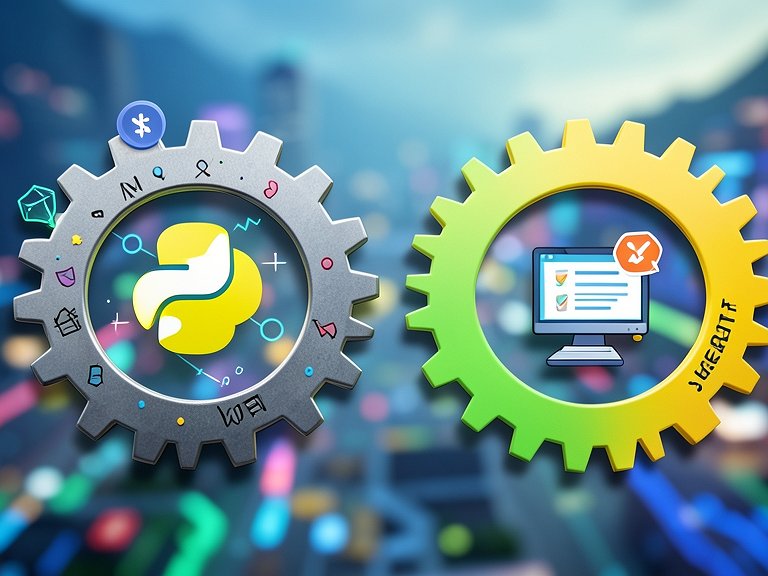
Python vs. JavaScript: The Ultimate Choice for Your Coding Journey
In short: The choice between Python and JavaScript as your first programming language heavily depends on your goals. Python shines with its simplicity and versatility in data science and backend development, while JavaScript dominates the web with its ubiquity and full-stack capabilities. This article will help you determine which language better suits your learning objectives and where to find support.
Starting your journey into programming can feel overwhelming. One of the first and most crucial decisions is choosing the 'right' first programming language. Often, two giants stand out: Python and JavaScript. Both are incredibly popular, versatile, and in high demand, but they have distinct strengths and typical use cases. This article will help you weigh the pros and cons to make an informed decision for your individual learning path.
1. Python: The All-Rounder for Beginners and Data Enthusiasts
Python is renowned for its clear, readable syntax, often compared to pseudocode. This makes it an excellent choice for beginners.
1.1. What makes Python so appealing?
- Easy Learning Curve: The syntax is intuitive and easy to grasp, reducing frustration for newcomers.
- Versatility: Python is used in an enormous range of applications: web development (with frameworks like Django or Flask), data science, machine learning (PyTorch, TensorFlow), automation, scripting, game development, and even desktop applications.
- Vast Community and Ecosystem: There are countless libraries and frameworks that simplify almost any task. The community is huge and supportive.
- High Demand: Python developers are highly sought after in the job market, especially in data analysis and AI fields.
1.2. Disadvantages of Python
- Performance: For high-performance real-time applications, Python can be slower than compiled languages like C++ or Java.
- Mobile Development: Although frameworks like Kivy exist, Python is not the primary choice for native mobile app development.
Tip: If you're interested in data analysis, artificial intelligence, or backend development, Python is often the more intuitive and direct choice for getting started.
2. JavaScript: The Language of the Web and Full-Stack Potential
JavaScript was originally a scripting language for web browsers to make web pages interactive. Today, it's far more than that – it's one of the most powerful and widely used languages in the world.
2.1. What makes JavaScript so appealing?
- Ubiquity on the Web: If you want to develop interactive websites or web applications, you can't avoid JavaScript. It runs in every browser.
- Full-Stack Development: With Node.js, JavaScript can also be executed on the server, making it a true full-stack language. You can develop both frontend and backend with a single language.
- Dynamic Ecosystem: Frameworks like React, Angular, and Vue.js dominate frontend development. The ecosystem is vast and evolving rapidly.
- Mobile Development: With frameworks like React Native or NativeScript, you can develop native mobile apps using JavaScript.
2.2. Disadvantages of JavaScript
- Complexity for Beginners: JavaScript's flexibility can be confusing for beginners, especially concepts like asynchronicity or interacting with the DOM.
- Browser Compatibility: Although it has improved, compatibility issues can still arise between different browsers.
- Lack of Type Safety (without TypeScript): JavaScript is dynamically typed, which can lead to runtime errors. Many developers therefore use TypeScript, a superset language that adds static typing.
Tip: If your main interest lies in web development (frontend, backend, or full-stack) or you want to create mobile apps, JavaScript is an indispensable and powerful choice.
3. Direct Comparison: Python vs. JavaScript
To help you decide, here's a direct comparison of the most important aspects:
3.1. Learning Curve
- Python: Considered more beginner-friendly. The syntax is clean, minimalist, and resembles natural language.
- JavaScript: Can be a bit steeper for beginners. The concepts are more diverse, and the syntax is more flexible, which can be confusing initially.
3.2. Typical Use Cases
- Python: Data science, Machine Learning, Artificial Intelligence, Backend web development, Automation, Scripting, Desktop applications.
- JavaScript: Frontend web development, Backend web development (Node.js), Mobile app development (React Native), Desktop applications (Electron), Interactive browser games.
3.3. Performance
- Python: For CPU-intensive tasks, it tends to be slower than JavaScript (when Node.js runs on the V8 engine). However, for many applications, the difference is negligible.
- JavaScript (Node.js): Very performant for I/O-intensive operations due to its asynchronous nature.
3.4. Community and Ecosystem
- Python: Large, mature community with a focus on scientific libraries, data analysis, and AI.
- JavaScript: Extremely active, fast-paced community with a focus on web frameworks and tools. The ecosystem evolves very rapidly.
Hands-on Block: Your First Code in Python and JavaScript
No matter which language you choose, the best way to learn is by doing. Here are two simple code examples demonstrating the basic syntax of both languages.
- Python – 'Hello World' and a simple loop:
# Hello World in Python
print('Hello Skill Tandem!')

# A simple loop
for i in range(5):
    print(f'Counting: {i}')
How it works: Python uses
print()for output. Loops are defined withforandrange(), and code blocks are structured by indentation. - JavaScript – 'Hello World' and a simple loop:
// Hello World in JavaScript
console.log('Hello Skill Tandem!');

// A simple loop
for (let i = 0; i < 5; i++) {
    console.log(`Counting: ${i}`);
}
How it works: JavaScript uses
console.log()for output. Loops are defined withforand curly braces{}for code blocks.
Try running these examples in an online editor (like Replit) or your local development environment. Experiment with small changes!
4. Who is each language suitable for?
- Choose Python if...
- You are an absolute programming beginner and are looking for a language with a gentle learning curve.
- You are interested in data science, machine learning, or artificial intelligence.
- You want to write backend development or automation scripts.
- You value a wide selection of specialized libraries.
- Choose JavaScript if...
- You want to develop interactive websites or web applications (frontend).
- You want to become a full-stack developer and are looking for a language for both frontend and backend.
- You want to create mobile apps with a single codebase (e.g., with React Native).
- You are looking for a language that plays a role in almost all modern technologies.
Conclusion: Your Goals Determine the Path
There is no 'best' programming language, only the one that best suits your goals and interests. Both Python and JavaScript are excellent languages with huge demand in the job market and active communities. Many professional developers, by the way, master both languages, as they complement each other well in their application areas.
Start with the language that appeals to you most and whose applications fascinate you. The most important thing is to start and keep going!
No matter if you choose Python or JavaScript: On Skill Tandem (skilltandem.app), you'll find like-minded individuals to learn, practice, and motivate each other. A learning partner can help you overcome hurdles and make the learning process more exciting. The platform is completely free!
Sign up for free and find a learning partner now!
FAQ: Frequently Asked Questions about Python and JavaScript
Which is easier to learn, Python or JavaScript?
Python is generally considered easier for beginners to learn due to its highly readable syntax, which is closer to natural language. JavaScript can be more complex initially due to its asynchronous nature and the need to understand browser APIs.
Can I learn both languages?
Yes, absolutely! Many professional developers are proficient in both Python and JavaScript, as they are often used in different parts of a project or in different domains. Being proficient in both is actually a highly sought-after skill.
Which language is better for web development?
For frontend web development (everything that happens in the browser), JavaScript is indispensable. For backend web development, both Python (with frameworks like Django or Flask) and JavaScript (with Node.js) are excellent and widely used options.
Which language offers better career prospects?
Both languages offer excellent career opportunities and salaries. Demand for developers with Python skills is particularly high in data science and AI, while JavaScript developers are highly sought after across the web and mobile sectors. The choice depends more on the specific career path you wish to pursue.
Should I consider anything special before learning a programming language?
Focus on the fundamentals of computer science, such as variables, loops, conditionals, and functions. Choose a small project that motivates you and learn by actively applying your knowledge. A learning partner can also be very helpful for clarifying questions and staying motivated.



0 Comments
No comments yet. Be the first to write something! 🎉