
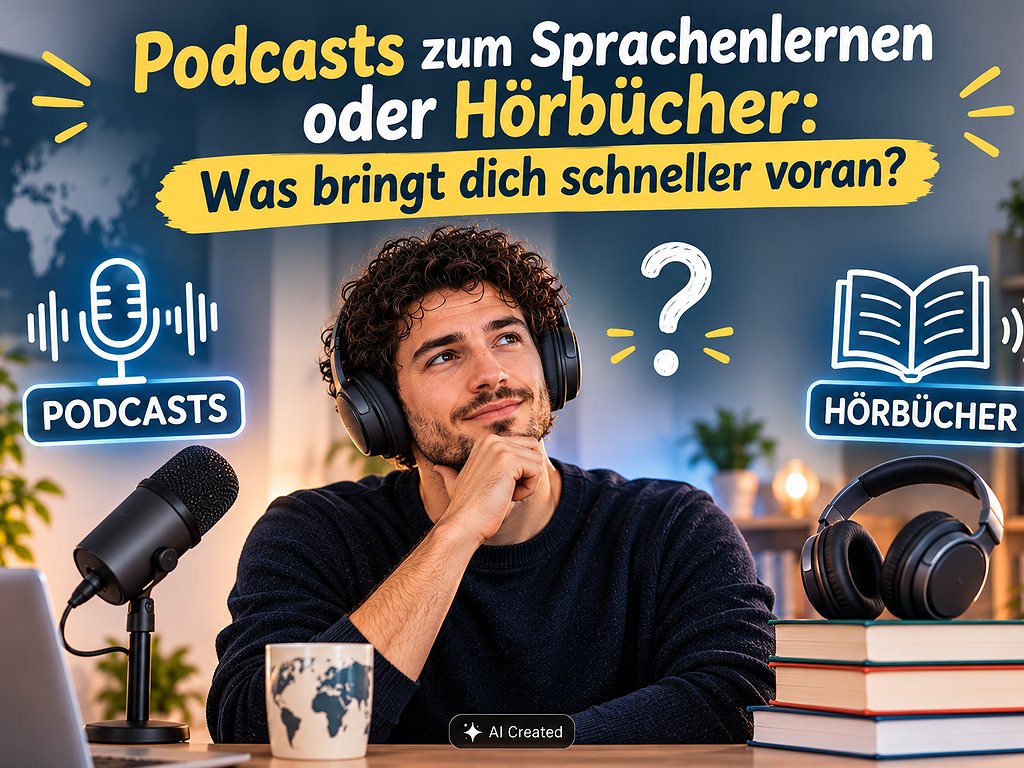
1. Introduction: Why this comparison matters
Many learners wonder whether podcasts or audiobooks accelerate their language learning more effectively. Both provide authentic listening practice, but their effects depend on your goals, proficiency level and study routine. This article breaks down when each format leads to faster, measurable progress.
You will get actionable exercises, a 4-week practice plan and concrete metrics to evaluate which format works best for you. By the end, you can choose the right approach and optimize your weekly practice.
In short: Podcasts offer flexible, repeatable conversational practice ideal for daily routines; audiobooks build listening stamina, narrative comprehension and deeper vocabulary. Below you’ll find how to combine both for fastest gains.
2. The exact problem we solve
Many learners listen to audio passively and then wonder why their listening skills stagnate. The root problems are often lack of structure, inappropriate material choice and missing active follow-up. Without targeted exercises, comprehension gains are limited.
This comparison solves that issue by helping you pick the right format for your immediate goals, providing exercises and a measurement system to track progress objectively.
3. Podcasts vs Audiobooks: Pros and Cons
3.1. Advantages of podcasts
Podcasts are short, topical and often conversational, making them excellent for daily repetition. Episodes ranging from 5 to 60 minutes fit busy schedules and allow targeted practice. Many podcasts include transcripts or show notes, which are extremely useful for language learners.
Podcasts also stay current with slang and real-life discourse, increasing your practical vocabulary for real conversations.
3.2. Disadvantages of podcasts
Audio quality and speaking styles vary widely. Fast or mumbled speech can overwhelm learners, and fragmented formats might lack the narrative structure helpful for longer comprehension training. Without transcripts, valuable vocabulary can be missed.
3.3. Advantages of audiobooks
Audiobooks provide coherent narrative structures, recurring vocabulary and sustained listening that trains inference and contextual understanding. Professional narration often improves clarity and exposes you to natural intonation and rhythm.
Parallel reading (having the text while listening) can dramatically boost retention and pronunciation accuracy.
3.4. Disadvantages of audiobooks
Audiobooks demand longer attention spans and greater time investment, which can be a barrier for learners with limited daily time. Many titles are paid (e.g. via Audible), although libraries may offer digital loans.
4. Who should use which format?
4.1. Beginners / A1-A2
Beginners benefit most from short, clearly spoken podcasts with transcripts or beginner-targeted series like "news in slow" formats. These allow repeated exposure to core vocabulary and simple sentence structures.
Audiobooks are usually too complex at this stage unless paired with the written text and chosen carefully (children's books or graded readers work best).
4.2. Intermediate / B1-B2
Intermediates gain a lot from native speaker podcasts to improve listening to idioms and connected speech. Short stories and simplified audiobooks become effective for building coherent listening skills and sustained attention.
4.3. Advanced / C1+
Advanced learners should use audiobooks to stretch their comprehension across long-form narratives and complex grammar, while podcasts can keep vocabulary current and topical. This group benefits most from a combined approach.
5. Cost and accessibility (quick overview)
Podcasts are largely free and easy to access via platforms like Spotify and Apple Podcasts. Audiobooks often require payment but can be borrowed through library services like OverDrive or Libby.
For budget learners, podcasts plus library audiobooks are the most cost-effective strategy.
6. Practical exercises: 4 exercises per format
6.1. Podcast exercises
- Three-pass listening: 1) listen for gist, 2) follow transcript and mark unknowns, 3) shadow and recall key points. This builds active listening and speaking.
- Cloze transcription: Remove key verbs or nouns from a transcript and fill them in after a second listen to practice inference and collocation.
- Question-and-answer production: Write five questions about the episode and answer them aloud, recording yourself for comparison.
- Weekly thematic deep-dive: Pick a topic and listen to several episodes to build a focused vocabulary bank.
6.2. Audiobook exercises
- Chapter summary: After each chapter, write a short oral or written summary to train narrative comprehension.
- Parallel reading: Listen while reading the printed text to link pronunciation and spelling.
- Character relationship mapping: Build a visual map of characters and relationships to track plot and implicit meaning.
- Variable speed listening: Listen at slower and faster speeds to train both clarity and processing speed.
7. How to measure what works
Use measurable indicators to see which format accelerates learning more effectively for you:
- Comprehension rate: Percent of sentences understood on first listen (track weekly).
- Active recall: Number of facts or phrases correctly recalled after 24 hours.
- Vocabulary transfer: Proportion of new words actively used in production after one week.
Keep a simple log and adjust materials if comprehension drops below 50% for consistent practice.
8. Common mistakes and fixes
Typical mistakes include passive consumption, picking material at the wrong difficulty, and skipping production activities. Fix these by using active tasks, calibrating difficulty with brief comprehension tests and adding speaking tasks such as shadowing and summaries.
Pro tip: Set micro-goals like "learn 10 new words per week" and check them actively in conversation practice.
9. Practice block: 5-step plan (section class='blog-praxis-block')
Follow this 4-week routine to combine podcasts and audiobooks for measurable improvement.
4-Week Action Plan: Combine Podcasts & Audiobooks
This plan fits learners at B1/B2. Adjust durations for other levels.
- Step 1 – Baseline: Day 1: Listen 15 minutes of podcast and 15 minutes of audiobook. Record your comprehension % and 10 unknown words.
- Step 2 – Daily Routine Week 1: 20 minutes podcast (active tasks) and 20 minutes audiobook (read along twice weekly). Log progress.
- Step 3 – Vocabulary Week 2: Extract 5 podcast + 5 audiobook words daily. Learn with SRS (Anki) and produce sentences.
- Step 4 – Production Week 3: Create two short voice recordings: a podcast summary and an audiobook chapter retell. Review pronunciation and clarity.
- Step 5 – Evaluate Week 4: Repeat baseline measures and compare. Decide which format produced bigger gains and plan next steps.
10. Two learner scenarios
Case 1: Anna (B1) used daily podcasts with transcripts and shadowing and improved listening comprehension significantly within six weeks. Case 2: David (C1) used audiobooks and parallel reading to refine his academic listening and increased comprehension of lectures and long monologues.
These examples show that podcasts accelerate conversational listening, while audiobooks deepen narrative processing and vocabulary retention.
11. Useful tools and resources
Recommended platforms include Spotify and Apple Podcasts for many free shows. For audiobooks, Audible and library apps like OverDrive/Libby are practical choices. For spaced repetition, use Anki.
Reminder: Libraries are an excellent cost-free resource for audiobooks and e-books.
Conclusion: Which is faster?
There is no one-size-fits-all answer. Podcasts often yield quicker short-term improvements in conversational listening and pronunciation due to frequency and ease of repetition. Audiobooks typically produce stronger long-term gains in comprehension, vocabulary depth and listening stamina.
Best practice: Combine both. Use podcasts for daily micro-learning and audiobooks for weekly deep dives. Apply the measurement techniques in this article to identify what accelerates your learning the most.
Skill Tandem CTA
Looking for a language partner in Austria to practice podcasts or audiobook summaries together? Skill Tandem is a completely free platform to find a matching learner or mentor. Exchange episodes, schedule shadowing sessions and accelerate your progress.
Sign up for free and start your tandem practice today.
FAQ: Frequently Asked Questions about Podcasts vs Audiobooks
How much does podcast-based learning cost compared to audiobooks?
Podcasts are largely free via platforms like Spotify and Apple Podcasts. Audiobooks often require payment (e.g. Audible), though libraries can provide free access.
How long until I see improvements in listening with these formats?
With focused, active practice of 30–40 minutes daily, learners commonly notice improvements within 4–8 weeks. The key is consistent, active engagement rather than passive listening.
Which format is better for improving pronunciation?
Podcasts with shadowing exercises are excellent for pronunciation and rhythm because they mirror conversational speech. Reading along with audiobooks also improves pronunciation by linking sound to spelling.
Can I use both formats in the same study plan?
Yes — combining daily podcasts for regular practice and audiobooks for longer focused sessions is often the most effective approach for balanced progress.
How do I select suitable material for my level?
Pick material slightly above your current level and use a quick comprehension check. If you understand less than 50% on first listen, choose simpler content or use transcripts to scaffold understanding.

Guter Ansatz, aber finde die Unterscheidung zu schwarzweiß, Podcasts nicht immer aktivierender als Hörbücher, kommt auf die Episode an.