
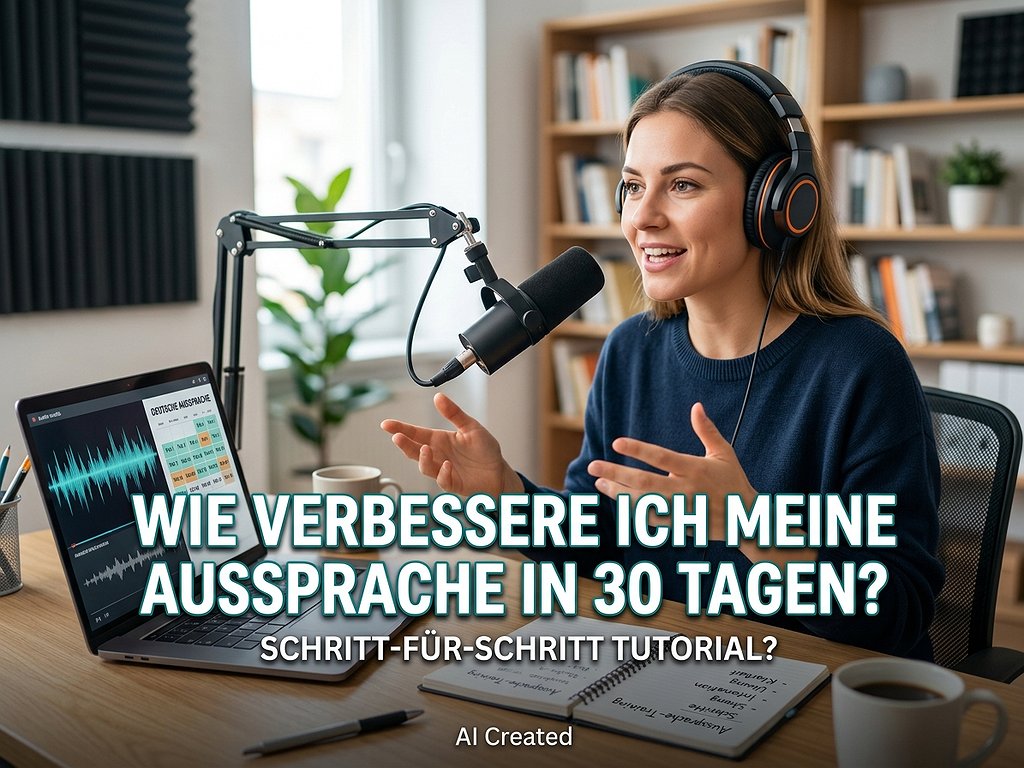
1. Introduction: Can you noticeably improve pronunciation in 30 days?
Short answer: Yes — with focused daily practice, recordings, and partner feedback you can make clear improvements in 30 days. This tutorial provides a day-by-day framework, concrete exercises, and measurable outcomes you can use immediately.
This guide is hands-on: you get exact warm-ups, sound drills, shadowing tasks, recording routines and partner session agendas. It works for learners from A2 to C1 aiming to speak more clearly and naturally.
The structure prioritizes consistency: short daily exercises, weekly sound focuses and regular live feedback. Every step includes concrete examples to try at home.
2. Problem / Goal – What you'll be able to do after this tutorial
After completing this 30-day plan you will be able to identify and reduce common pronunciation mistakes, improve intonation and rhythm, and speak more intelligibly. You'll practice specific sounds (e.g., English 'th', vowel contrasts, German umlauts) and measure improvement objectively.
Concrete gains: clearer vowel differentiation, cleaner consonants, more natural sentence stress and greater confidence in conversations. You'll also learn how to use a tandem partner or mentor effectively.
The plan is achievable because exercises are short, targeted and repeatable — perfect for daily practice sessions.
3. Requirements & Time commitment
What you need: a smartphone or computer with a microphone, a recording tool (e.g., Voice Memos, Audacity), access to native audio for shadowing and ideally a tandem partner. You can add automated pronunciation tools for extra feedback.
Specific items:
- Smartphone with recording app (e.g., Apple Voice Memos)
- Free audio editor: Audacity
- Native audio resources: Forvo and Librivox
- Find partners on Skill Tandem
Time: 30 days, daily 15–40 minutes. Recommended: 5–10 min warm-up + 10 min focused drills + 5–15 min recording/feedback. If pressed, do a 15-minute session focusing on warm-up and 5 minutes of shadowing.
4. Step-by-step guide
Follow these steps through the 30-day program. Each step includes concrete examples you can speak, record and evaluate immediately. Keep a practice log to track progress.
4.1. Step 1: Create a baseline (Day 1)
Why: Without a baseline you cannot measure improvement. Record a short baseline sample to compare later.
-
Concrete example:
Record 2 minutes: 1) Introduction: "Hi, I'm Alex. I've been learning English for two years. My goal is to speak more clearly." 2) Read a short passage: "The quick brown fox jumps over the lazy dog." Save as 'Day1_Baseline'.
Tip: Use Voice Memos or Audacity and keep the file labeled for easy comparison.
-
Expected result:
You will have a reference audio to track pronunciation, pace (words/minute) and intonation later.
4.2. Step 2: Daily warm-up (Days 2–30, 5–10 minutes)
Why: Warming up speech muscles improves clarity and reduces strain.
-
Concrete example - 5-minute routine:
Lip trill (30s), tongue rolls (30s), vowel glide: "a - e - i - o - u" (5 reps each), consonant chain: "p - t - k - b - d - g" (5 reps each).
Tip: Focus on precision not volume. Aim for consistent mouth shapes.
-
Expected result:
Smoother articulation and greater control over mouth and tongue positions.
4.3. Step 3: Weekly focus sound (7 days per sound)
Why: Intensive work on one sound yields faster gains. Plan four weeks for four focus sounds.
-
Week 1 example (English target for a German speaker): 'th' (/θ/ and /ð/)
Daily 10-minute drill: minimal pairs (thin - tin), word list: think, this, both, brother, mother (5x each), sentences: "This is the thing that they think about." (5 shadow reps).
-
Week 2 example: vowel contrast 'iː' vs 'ɪ'
Practice word pairs: beat/bit, seat/sit, leave/live. Record and note differences.
-
Week 3 example: German umlauts (ö, ü) for non-native learners
Practice vowel matching: say 'schön', 'Löwe', 'fünf' slowly and hold the vowel for 3 seconds each.
-
Week 4 example: intonation & sentence melody
Practice yes/no questions vs statements: "Are you coming?" vs "You are coming." Record both and compare the rise-fall patterns.
4.4. Step 4: Shadowing & chunking (Daily 10–15 minutes)
Why: Shadowing helps with connected speech, stress and rhythm.
-
Concrete example:
Select a 30–60s native audio clip from Librivox. Play 10s, pause, repeat immediately by imitating rhythm and tone: "Every morning she walks to the bakery to buy fresh bread." Repeat 5 times.
-
Expected result:
Better connected speech and more native-like intonation patterns.
4.5. Step 5: Record & analyze (Daily 5–15 minutes)
Why: Listening back reveals errors you don't notice while speaking.
-
Concrete example:
Record 30–60s of your practice phrase daily. Compare with Day1_Baseline and list 3 specific differences (e.g., pronounced 'th' clearer, reduced vowel centralization, smoother sentence endings).
Tip: Track tempo (WPM) and mark recurring errors in a simple table or note list.
-
Expected result:
Clear view of problem areas and progress evidence.
4.6. Step 6: Tandem feedback & live correction (2x per week)
Why: Human partners give contextual corrections and help practice real conversation.
-
Concrete example:
Two 30-minute sessions weekly via Skill Tandem. Agenda: 5-minute warm-up, 10-minute targeted drills, 10-minute roleplay with immediate feedback, 5-minute wrap-up with homework.
-
Expected result:
Faster correction cycles, practical conversation practice, more motivation and accountability.
5. Practice exercise – Hands-on session with expected result
This 20-minute drill demonstrates immediate improvement potential. You only need a phone and 20 minutes.
- Record 60s baseline: "Hello, my name is [Name]. I practice pronunciation to speak more clearly. Today I will focus on the 'th' sound."
- 5-minute warm-up as described above.
- 10-minute focus: say 5 words (think, this, both, brother, with) 10x each, then the sentence "This is the thing that they think about." 5x shadowed after a native audio model.
- Record the same 60s baseline text again.
- Listen to both recordings; note 3 improvements (e.g., 'th' clearer; articulation crisper; faster but still intelligible). Measure WPM change if desired.
Expected outcome: a perceptible reduction in mispronounced 'th' tokens and a slight increase in fluency, visible by comparing the two recordings.
6. Common mistakes & fixes
- ❌ Mistake: Practicing irregularly. → ✅ Fix: Set a fixed daily time slot; use calendar reminders and mini-goals.
- ❌ Mistake: Focusing on too many sounds. → ✅ Fix: One focus sound per week with measurable tasks.
- ❌ Mistake: Relying solely on apps. → ✅ Fix: Combine automated tools with human feedback (tandem or tutor).
- ❌ Mistake: Ignoring prosody. → ✅ Fix: Add daily shadowing for rhythm and intonation practice.
- ❌ Mistake: Not tracking progress. → ✅ Fix: Keep a simple weekly log with WPM, error count and self-rating.
7. Measuring progress (concrete metrics)
Use simple, repeatable metrics: WPM from 60s recordings, count of mispronounced target sounds in a 20-word passage, and a 1–5 clarity rating. Record once per week and chart changes.
- WPM example: Week 1 = 92 WPM; Week 4 = 105 WPM.
- Error count example: 5 target errors in Week 1 → 1–2 by Week 4.
- Clarity rating example: Start 2/5 → End 4/5.
8. Tools & resources
Recommended tools for effective practice:
- Audacity – for recording and waveform comparison.
- Forvo – native pronunciation samples.
- Librivox – free audio for shadowing.
- Duolingo – supplementary drills and vocabulary practice.
9. Conclusion: Key takeaways
30 Tage gezieltes Training bringen spürbare Verbesserungen in Aussprache, Intonation und Verständlichkeit. Folge dem klar strukturierten Plan: Baseline, tägliche Warm-ups, wöchentliche Fokuslaute, Shadowing, Aufnahmeanalyse und Tandem-Sessions. Kleine, tägliche Fortschritte summieren sich zu messbaren Veränderungen.
Skill Tandem is the perfect platform to find language tandem partners in Austria and start practicing with real people. Sign up for free and arrange your first feedback session today.
FAQ: Frequently Asked Questions about improving pronunciation in 30 days
How much time per day do I need to see results?
Daily practice of 20–30 minutes yields noticeable improvements within 2–4 weeks. Even 15 minutes daily can produce measurable changes if you are consistent and focused.
Do I need a native speaker to improve?
No. Native audio and apps help, but a native or fluent tandem partner accelerates progress by giving real-time corrections and natural conversation practice.
Which sounds should I focus on first?
Start with the sounds that cause the most communication problems. Use baseline recordings to identify 1–2 recurring errors, then dedicate a week per sound with minimal pairs and drills.
Can apps replace a teacher?
Apps provide instant, objective feedback and are useful for drills. However, teachers and tandem partners provide tailored corrections and explanations you won’t get from an app alone.
How do I keep motivation over 30 days?
Set small weekly goals, track progress with simple metrics, celebrate wins (e.g., fewer errors), and schedule regular tandem sessions for accountability.


Würde mich interessieren ob die vorgeschlagenen Aufnahmeanalysen auch mit dem Handy ausreichen, oder besser ein externes Mikro nutzen 😊