
AI Washing: The New Term You Should Know
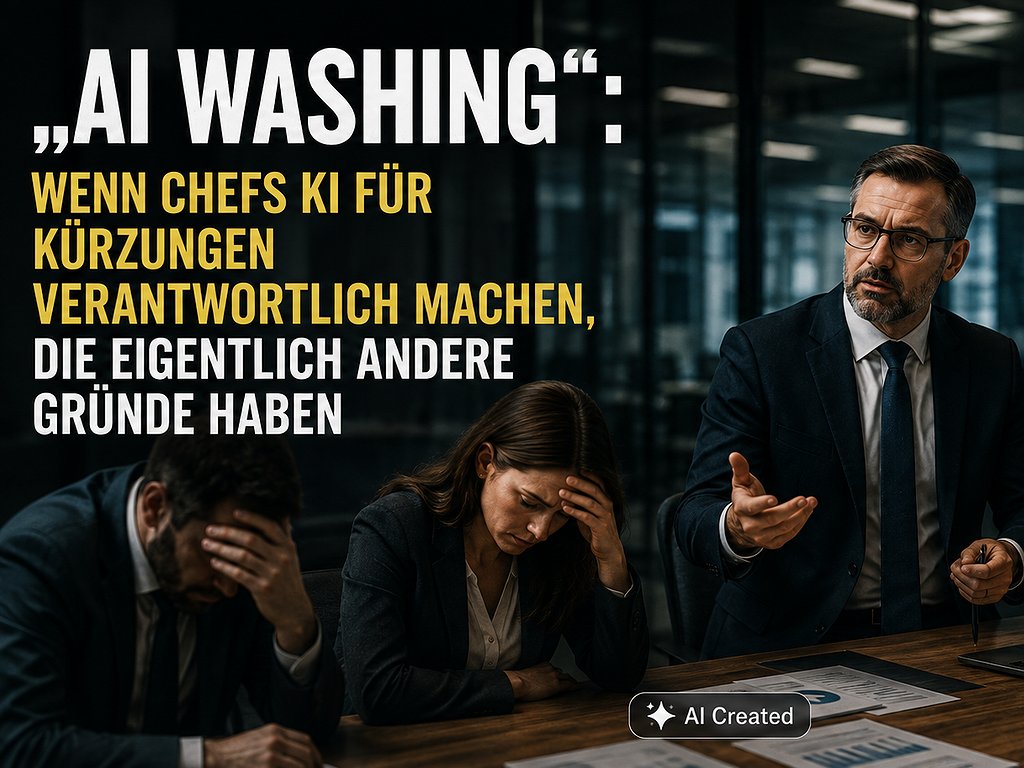
When Jack Dorsey announced in the spring of 2026 that his company Block would be laying off around 40% of its workforce – approximately 4,000 people – the public reason was clear: increased efficiency through AI. However, the reaction of many observers was skeptical. Was this really primarily an AI effect? Or was "AI" the most convenient, modern explanation for a cut that was inevitable anyway?
It is exactly this question that has given rise to a new term: AI Washing. In analogy to "greenwashing" (when companies portray themselves as greener than they actually are), AI Washing describes the practice of attributing layoffs to AI, even though the actual causes lie elsewhere. A new tracking tool named JobLoss.ai, launched by the "Alliance for Secure AI", has since been trying to systematically distinguish which cuts are actually AI-driven – and which are just being sold as such.
1. What Exactly is AI Washing?
AI Washing refers to the strategic communication of personnel cuts, in which artificial intelligence is named as the main reason, although other factors (cost pressure, overcapacity from the post-corona adjustment wave, weak economy, restructuring, investor pressure) are actually decisive or at least play a much greater role than communicated.
Why Do Companies Do This?
- It Sounds Forward-Thinking: "We've invested heavily in AI" sounds better to investors than "We overhired in 2021 and are now correcting that".
- It Diverts Attention from Mismanagement: Overcapacity from the pandemic era is a leadership error. AI efficiency sounds like strategic foresight.
- It Positively Influences the Stock Price: Companies that are considered "AI-First" are often valued higher by investors at present.
- It Makes Firings Less Personal: "The technology has changed" is easier to communicate than "We hired too many people too quickly".
2. How to Recognize AI Washing
=== ÜBERSETZTER HTML ===| Warning Sign | What it means |
|---|---|
| The company had a massive hiring wave in 2021/22 | Probably a correction of over-capacities, not primarily due to AI |
| No concrete numbers mentioned on AI productivity gains | Claim without evidence – be cautious |
| Cutbacks coincide with poor quarterly numbers | Probably primarily due to cost pressure |
| Affected roles are not those typically replaced by AI | E.g. sales or leadership positions – AI explanation implausible |
| The company communicates high AI investments to investors | Cutbacks may be a PR strategy to justify investments |
| The industry is generally under pressure (e.g. retail due to tariffs) | External factors are likely to be the main drivers rather than AI |
3. The other side: When is AI really the main driver?
Not every AI-related explanation is AI Washing. There are real cases where AI is actually the main driver:
- Customer service and content moderation: Here, chatbots and automated systems have proven to replace real work volumes. Salesforce (4,000 customer service roles) and Duolingo (contractor basis) are examples with direct and well-documented AI connections.
- Simple programming tasks: Coding assistants are increasingly taking over boilerplate tasks that previously junior developers used to do.
- Basic data analysis and reporting: Standardized analysis tasks are increasingly being automated.
The difference with AI Washing: These cases are often backed up with concrete process descriptions – not just the vague statement "AI makes us more efficient".
4. Why it matters for you as a job applicant
Understanding AI Washing is not an academic exercise – it has three very practical consequences for your career planning:
a) Less panic over "AI layoff" headlines
If you read that a company "had to lay off due to AI", it doesn't automatically mean that your job in a similar position is at risk. Check the warning signs from the table above before you start worrying.
b) Better assessment of potential employers
If you're applying to a company that recently had to lay off staff "due to AI", it's worth doing some more research: Is the explanation plausible? Was the company aggressively expanding beforehand? This gives you important clues about the actual company culture and stability.
c) More realistic self-assessment of your own replaceability
When you work in an area that is publicly considered "AI-risk prone," but the warning signs for AI Washing apply to your employer, the actual threat is likely to be economic pressure rather than pure automation. This changes what you should prepare for.
Praxis-Block: The 4-Question Check for every "AI Layoff" Headline
Before you take a layoff announcement as a pure AI sign, ask yourself these four questions:
- How strong was the company's growth beforehand? Check the employee count development over the last 3-5 years (often visible on LinkedIn or in business reports). Strong growth in 2021/22 plus layoff in 2026 = probably correction, not primarily AI.
- Are specific numbers mentioned? A company that says "our AI tool now handles the work that previously required 15 full-time employees" is more credible than one that only mentions "AI efficiency" vaguely.
- Which roles are specifically affected? Customer service, content moderation, and simple data processing are plausible AI targets. Sales, leadership, or complex consulting are less so.
- Does the story match the financials? A quick look at the latest quarterly reports often shows whether cost pressure or revenue decline provides a more plausible explanation than "we're just more efficient now".
Rule of thumb: The vaguer and PR-heavy the AI explanation, the more likely AI Washing. The more concrete with process description and numbers, the more likely an actual AI effect.
5. What this means for the public debate
AI Washing distorts not only individual career decisions but also the entire public debate about the AI impact on the job market. If media and politics believe AI replaces jobs faster and more extensively than it actually does, this can lead to poor decisions – from overregulation to misguided education planning.
That's exactly why initiatives like JobLoss.ai are important: They try to distinguish between "Explicit" (companies name AI explicitly as the reason), "Blamed" (at least one source mentions AI, even without official confirmation), and "Mixed" (AI is mentioned alongside other factors, but not as the primary reason). This differentiation is missing from most headlines.
6. Conclusion: Healthy skepticism over panic or naivety
Understanding AI Washing doesn't mean denying the real AI impact on the job market – it's undeniable. It means reading every headline more critically before letting it influence your own career planning. The ability to distinguish between genuine automation and PR storytelling will be an important skill in 2026.
Exactly this kind of critical thinking is fostered by Skill Tandem. On our platform, you exchange with other learners, compare assessments, question headlines together, and build not only expertise but also judgment – the meta-skill that will count in 2026. Sign up for free and start with a learning partner!
FAQ: Frequently Asked Questions about AI Washing
Is AI Washing illegal?
No, it's not a legal category, but a description of a communication strategy. Companies are not required to reveal the full truth about layoff reasons. However, misleading communication can have legal consequences for shareholders if it's proven to have deceived investors.
How can I, as an individual, recognize AI Washing when applying to a company?
=== ÜBERSetzter HTML ===Research the employee headcount development over the last years, current quarter numbers, and the specifically affected roles. Platforms like JobLoss.ai now offer structured assessments. A quick Google search for "[Company] layoffs reason" often delivers additional insightful information.
Does AI Washing also affect Austrian and German companies?
The term and debate primarily stem from the US context, but the pattern is transferable. Companies in DACH are increasingly naming AI as the reason for restructuring. A similar critical examination is also sensible.
What is the difference between AI Washing and Greenwashing?
Both describe misleading PR strategies. Greenwashing exaggerates a company's environmental friendliness. AI Washing exaggerates or invents the KI connection of decisions – mostly in layoffs but also in product announcements.
Should I avoid companies that practice AI Washing?
Not necessarily, but it is a warning signal for the company's communication culture. Companies that dishonestly communicate layoffs often do so in other areas as well. This is a relevant information for your decision to work there.
How can I generally develop more critical thinking when encountering such news?
Practice and exchange are most helpful. With a Tandem partner on Skill Tandem, you can jointly assess current headlines, discuss different perspectives, and thus systematically sharpen your judgment – much more effectively than researching alone.



Hab selbst schon erlebt, dass mein Chef KI als Grund für Entlassungen genannt hat, obwohl es eher um Kosteneinsparungen ging