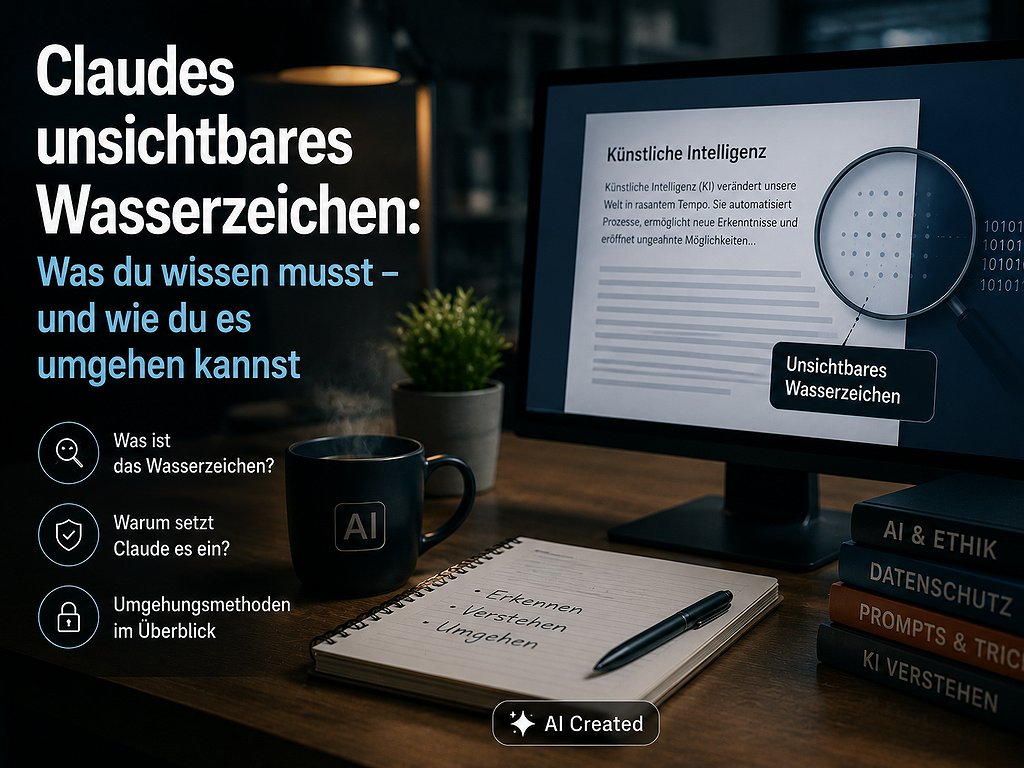
Claude’s invisible watermark: What you need to know — and how to bypass it
Since August 2026 it’s official: every text generated by Anthropics’ AI model Claude carries an invisible watermark. The measure is intended to comply with the EU transparency requirements — but it has triggered a wave of backlash. Developers around the world are working on tools to remove the AI markings. We explain how the watermark works, which bypass methods exist — and whether they really deliver what they promise.
1. Why Claude now inserts watermarks
The background is Article 50 of the EU AI Act, which has been in force since August 2, 2026. It requires providers of generative AI to label their outputs so they can be machine-recognized as AI-generated. Violations can result in fines of up to €15 million or 3 percent of global annual turnover.
Anthropic has decided to implement the labeling worldwide and for all Claude products — not only in the EU. Affected are the API, claude.ai, Claude Code, Claude Cowork and Claude Tag as well as all usages via AWS, Google Cloud and Microsoft Foundry.
The watermarks are inserted at the model level, are invisible to human readers and do not affect the meaning or readability of the texts.
2. How the invisible marking works
Anthropic uses the SynthID-Text method from Google DeepMind for text labeling. This is a statistical procedure that leaves a machine-readable pattern in the model’s word choices.
It works like this: where Claude can choose between several equally suitable words — for example “overcast” instead of “gray” for the weather report — it makes a decision that creates a statistical pattern. For a human reader the choice is invisible, but with the appropriate decoder it is clearly detectable.
In addition, Claude inserts signed C2PA provenance information into the metadata of files like PNG, JPEG, PDF or DOCX.
| Metric | Detail |
|---|---|
| Introduced | Since August 2026 for all new Claude models |
| Affected products | API, claude.ai, Claude Code, Claude Cowork, Claude Tag |
| Technical basis | SynthID-Text from Google DeepMind |
| Also for files | C2PA metadata in PNG, JPEG, PDF, DOCX, etc. |
3. The pitfalls: What the watermark does not mean
The marking is less definitive than it sounds. Anthropic itself admits:
- A detected watermark does not prove that Claude wrote the entire text. If you have your own text translated, corrected or summarized, you will also receive a marked output.
- Conversely: No watermark does not mean "human-made". Heavy editing, translation, or paraphrasing can destroy the signal.
- Very short texts are unsuitable for a reliable attribution.
The watermark therefore more likely indicates a Claude involvement than a definitive authorship.
4. The bypass tools: What they can do — and what they can't
The announcement from Anthropic triggered a wave of tools that aim to remove the watermark. The best-known example is the open-source project "Watermarks Remover" by developer Guillaume Meyer, which gathered over 15,000 stars on GitHub within a few days.
The tools follow three different approaches — with very different effectiveness:
a) Removing invisible characters — works
Tools can reliably remove zero-width characters, bidirectional control characters, and similar Unicode artifacts from the text. This is technically simple and verifiable. However: these characters are not the actual watermark — they are more of an additional signal.
b) Removing C2PA metadata from files — also works
The signed provenance information in images, PDFs, and Office documents can be deleted without problems. That is not a big trick either — metadata doesn't survive re-saving, format conversion, or a screenshot.
c) Removing the actual statistical watermark — uncertain
Here it gets difficult. The statistical watermark is embedded in the model’s choice of words — there is no single character you can delete. The only known method: comprehensively rewriting the text, for example with another AI model.
Meyer is surprisingly honest on this issue: his tool currently only removes metadata; it cannot eliminate the actual watermark. Commercial providers are less cautious — independent tests have already revealed gaps in their claims.
5. Further strategies to bypass watermarks
In addition to the specialized tools, various other methods are being discussed:
- Translate into another language and back (for example English → Arabic → English) — the differing semantics can destroy the watermark.
- Extensive paraphrasing with another AI model that does not insert watermarks.
- "Humanizer" skills for Claude code that instruct the AI to avoid certain AI-typical language patterns.
However: Until Anthropic releases its watermark detector, it's hard to verify whether a method actually works.
Practical block: What you should do now
The watermark discussion affects you if you use Claude regularly for your work. Here are the most important recommendations:
- Understand what the watermark means: It marks Claude's involvement, not necessarily a complete AI generation. For many legitimate uses (translation, proofreading, structuring) this is perfectly fine.
- Be careful with bypass tools: Most browser tools remove only obvious Unicode artifacts, not the actual watermark. You may be paying, at best, for text formatting in a trench coat.
- For professional use: If you use Claude for texts that later must be labeled "human-made," you should thoroughly revise the outputs – or use a different model without a watermark.
- Stay informed: Anthropic is expected to release a watermark detector. Only then can it really be tested which circumvention methods work.
6. Conclusion: A cat-and-mouse game with an open outcome
The introduction of AI watermarks is the direct consequence of EU regulation – and it’s here to stay. The current wave of evasion tools shows how difficult it is to find a robust technical solution for transparency that does not also penalize legitimate uses.
For you as a user: the watermark is not a reason to panic. It mainly indicates that Claude was involved in the text – which is completely normal in many workflows. Evasion tools are currently more placebos than real solutions. The only reliable method to remove the statistical watermark is a thorough substantive revision – and that is good practice anyway when you use AI texts for serious purposes.
FAQ: Common questions about Claude’s watermark
What exactly is an AI watermark?
An invisible, machine-readable pattern woven into the text. In Claude it is based on the statistical choice of words (SynthID text) and is not detectable by humans.
Does the watermark affect me as a Claude user?
Yes, every output from new Claude models (since August 2026) is affected – worldwide, without exception.
Can I simply remove the watermark?
The invisible marks and metadata can be easily removed. The statistical core watermark cannot be removed without extensive rewriting of the text. Current tools promise more than they can deliver.
Will my text be detected as "AI-generated" if I only use Claude for proofreading?
Possibly – because translated, corrected, or summarized texts also receive the watermark.
What happens if I translate the text into another language?
A translation can destroy the watermark, since the statistical patterns in word choice are not preserved.
Is there already a detector for the watermark?
Not yet. Anthropic has announced the release of a detection API. Until then, the effectiveness of evasion methods cannot be verified.



Wenn du tiefer einsteigen willst, kann ich das Buch "Künstliche Intelligenz und Recht" empfehlen, passt gut zur Diskussion um Wasserzeichen und Regulierung.