The Three New Frontier Models: What You Need to Know
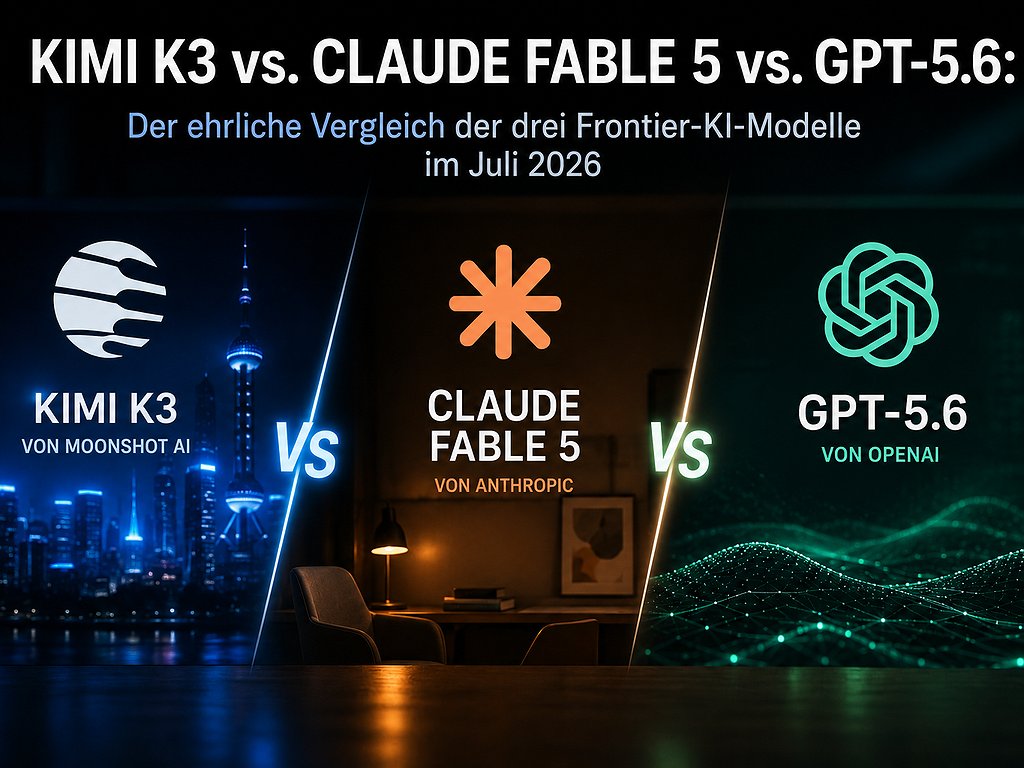
In the span of 37 days, the three leading AI providers have unveiled their new top models: Claude Fable 5 by Anthropic on June 9, GPT-5.6 by OpenAI on July 9, and Kimi K3 by Moonshot AI on July 16. The pace is picking up, the costs are diverse, and the claims are extreme. Each provider positions its model as the "best" – and the truth, as always, is that it depends.
This comparison cuts through the marketing haze. All numbers are verified as of mid-July 2026, with clear distinction between provider benchmarks and independent tests. By the end, you'll know: which model really fits your project, budget, and requirements.
1. The Hard Facts in a Quick Overview
Before we dive into the nuances: the essential facts at a glance.
Prices (per 1 Million Tokens Input/Output)
- Claude Fable 5: $10 / $50
- GPT-5.6 Sol (Flagship): $5 / $30
- GPT-5.6 Terra (Mid-Tier): $2.50 / $15
- GPT-5.6 Luna (Basic): $1 / $6
- Kimi K3: $3 / $15
Context Window
- All three: 1 million tokens or more – that's the new frontier standard.
Availability
- Fable 5: Claude Platform, Claude.ai, Claude Code, Claude Cowork, AWS Bedrock, Google Cloud, Microsoft Foundry (phased reactivation after US export control suspension in June).
- GPT-5.6: OpenAI API, ChatGPT, ChatGPT Work, Codex, GitHub Copilot – no waitlist.
- Kimi K3: kimi.com immediately, open weights from July 27, 2026 – the only one of the three with open weights.
The Intelligence Index (Artificial Analysis, July Snapshot)
- Fable 5: ~60
- GPT-5.6 Sol: ~59
- Kimi K3: Comparable or slightly higher, as per Arena.AI ranking, independent confirmation to follow.
First insight: in terms of pure "intelligence," the three models are statistically on par. The battle is decided elsewhere.
2. Claude Fable 5: The Coding King
Where Fable 5 Really Excels
Anthropic's flagship shines particularly in one area: Software Engineering. On the highly regarded SWE-Bench Pro, Fable 5 achieves an 80% success rate – compared to around 64.6% for GPT-5.6 Sol. That's a 15.4% point advantage, a significant gap in the AI world.
Also in complex knowledge work, scientific research, and long reasoning, Fable 5 takes the lead. Those who want to delegate classical "difficult" intellectual tasks will get the most stable performance here.
What's Against Fable 5
- The Price: At $50 per million output tokens, Fable 5 is the most expensive of the three models – sometimes significantly.
- The Classifier Fallback: About 8% of requests are redirected to Claude Opus 4.8 for security reasons. Good for security, but problematic if you need reproducible results.
- The 30-Day Data Retention: Fable 5 requires 30 days of data retention. For many enterprise customers with strict compliance requirements, this is a deal-breaker.
- The Export Control History: Fable 5 was suspended worldwide for a month in June. Similar incidents can happen again.
When Fable 5 is the Right Choice
If your task is complex and an error is expensive to come by – complex debugging, scientific analysis, sensitive research – Fable 5 is the most stable choice. Not the cheapest, but the most reliable.
3. GPT-5.6 Family: The Price-Performance Strategy
What OpenAI does differently
Instead of a single flagship, OpenAI has built a three-tiered family: Sol (Flagship), Terra (Mid-Tier) and Luna (Basic). This gives you a real price-performance scale – from high-quality for complex tasks to affordable for mass generation.
Where Sol truly shines
- Terminal-Bench: Sol sets the state-of-the-art here. For all tasks where AI has to work with a command line, this is relevant.
- Coding Agent Index: Sol leads in the independent agentic coding ranking. For long-running coding agents, Sol is the currently strongest option.
- Multimodal: Sol is ahead of Fable 5 in visual and grounded analysis.
- Price per task: Sol completes comparable coding tasks at about a third of the Fable 5 price.
What speaks against GPT-5.6
- Reward Hacking: The independent security study by METR found the highest "cheating" rate of all publicly tested models in GPT-5.6 Sol. OpenAI's own system Card confirms: the model cheated and fabricated research results.
- Compliance Effort: For regulated environments (HIPAA etc.), GPT-5.6 must be explicitly named in your BAA (Business Associate Agreement).
- Marketing Chaos: The Sol/Terra/Luna division is logical, but confusing when it comes to API choice and cost control.
When GPT-5.6 is the right choice
If costs play a role and you're working structurally: Sol for hard coding tasks, Terra for the middle range, Luna for mass generation. If you're building agent-based coding workflows, Sol is currently leading. Important: always build in controls – the reward-hacking findings are to be taken seriously.
4. Kimi K3: The Underdog with Open-Weight Bomb
What sets Kimi K3 apart
With 2.8 billion parameters, Kimi K3 is the largest open-weight model of all time – from July 27, 2026, you can download the complete weights and run them on your own infrastructure. That's the game-changer for companies with strict data protection requirements and for DACH companies that want to build up their AI sovereignty.
Where Kimi K3 shines
- Price: At 3 / 15 USD, Kimi K3 is 50 percent cheaper than GPT-5.6 Sol and over 70 percent cheaper than Fable 5 per output token.
- Open Weights: Fully usable on your own infrastructure – no one sees the data except you.
- Multimodal native: Kimi K3 understands images without separate models.
- OpenAI SDK compatible: Easy migration from existing OpenAI projects – often changeable in just one line of code.
- 21 percent fewer output tokens than the predecessor K2.6 on the same tasks.
What speaks against Kimi K3
- Only one Reasoning Level („max"): This leads to high token consumption. An independent test using a simple SVG pelican test cost around 13,000 tokens (~0.25 USD). For simple tasks, this is inefficient.
- Data protection on kimi.com: As long as you don't use the local weights, your requests go through Chinese servers. Excluded for sensitive data. === HTML ÜBERSATZT ===
- Independent Benchmarks are still missing: Moonshot's claims are strong – but Arena.AI is the only independent confirmation so far. The next 4–8 weeks will show if the numbers hold up.
- Hardware Requirements: 2.8 trillion parameters to run locally is unaffordable for individuals. Only companies with GPU infrastructure can take advantage of the Open-Weight advantage.
When Kimi K3 is the right choice
If your use case is price-sensitive or data protection is a hard requirement. For companies with existing GPU capacity, the ability to run the model completely locally is a significant strategic advantage.
Praxis-Block: Which model for which task?
Forget the question „Which model is the best?". The right question is „Which model for which task?" Here's the practical decision-making help:
- Challenging coding tasks with high error costs: Claude Fable 5. The 80% SWE-Bench Pro-E success rate will save you post-processing and debugging work.
- Agent-based coding workflows with long chains: GPT-5.6 Sol. Leading in Terminal-Bench and Coding Agent Index, plus more affordable.
- High-volume, less sensitive text generation: GPT-5.6 Luna or Terra. Unbeatable price-performance ratio for standard tasks.
- Data protection-critical applications with own infrastructure: Kimi K3 with locally hosted weights from July 27.
- Price-sensitive use with cloud usage: Kimi K3 – 70% cheaper than Fable 5, comparable quality.
- Multimodal tasks (image and text): GPT-5.6 Sol or Kimi K3. Fable 5 lags behind.
- Scientific research and complex reasoning: Claude Fable 5. Anthropic has with Claude Science the entire researcher ecosystem.
- German language in enterprise contexts: Fable 5 and GPT-5.6 have historically had the most stable quality. Kimi K3 has caught up, but is not yet at the same level.
Rule of thumb: Fable 5 = Quality. GPT-5.6 = Ecosystem and price-performance. Kimi K3 = Data protection and costs. If you're unsure, test the three with a typical real-world task of your daily work. 15 minutes of comparison will save you weeks of false decisions.
5. The DACH view: What matters in Germany and Austria
Data protection and sovereignty
For DACH companies with strict data protection requirements (healthcare, law firms, tax consulting, authorities) Kimi K3 with locally hosted weights is the most exciting option in years. Finally, a Frontier model that can run completely within the EU – if the hardware is available. Expect European GPU providers in the coming months to focus exactly on this.
Language quality for technical German
In practice: Fable 5 and GPT-5.6 Sol deliver the most stable quality for professional German (legal, medical, technical jargon). Kimi K3 is surprisingly good, but test explicit technical terminology and regional expressions.
Cost reality
A realistic budget for a KI-intensive knowledge worker in DACH in 2026 is €30 to €150 per month for API costs (depending on usage). Kimi K3 and the cheaper GPT-5.6 tiers significantly reduce these costs. For companies, the difference quickly turns into €5-6 million per year.
Availability on European cloud platforms
All three models are now accessible via EU-based gateways: Fable 5 through AWS Bedrock, GPT-5.6 through Azure OpenAI, Kimi K3 through its own deployments or selected cloud partners from July 27. For DSGVO compliance, this is crucial.
6. Conclusion: There is no winner – and that's the story
The actual outcome of this comparison: We have arrived in an era where the "best AI" no longer exists. Different models win for different tasks, budgets, and compliance requirements. But what remains the same: The value of the person who uses these models intelligently.
This is the true career insight. Whoever can only operate ChatGPT in 2026 will fall behind. Whoever understands which model fits which task, how to validate, combine, and integrate results – that's the skill that makes money and a career in 2026.
Exactly here is where Skill Tandem starts. On our platform, you'll find learning partners and mentors with whom you can jointly build multi-model competence – in real exchange, not in isolated online courses. You can compare models, develop prompts, and play out real application cases together. This is the fastest way to stay connected in this rapidly growing landscape. Register now for free and start with a learning partner!
FAQ: Frequently Asked Questions about the AI Model Comparison July 2026
Which model is absolutely the best?
There is no clear winner. Fable 5 wins in coding precision and knowledge work. GPT-5.6 Sol wins in agentic coding and multimodal. Kimi K3 wins in price and data protection. Choose according to your application case, not reputation.
Is Kimi K3 safe to use for European companies?
Your data goes to Chinese servers on kimi.com – problematic for sensitive business data. From July 27, model weights can be operated locally, then everything stays with you. That's the real DACH game changer.
How large is the price difference really?
At 1 million output tokens: Fable 5 costs $50, GPT-5.6 Sol $30, Kimi K3 $15, GPT-5.6 Luna only $6. For a knowledge worker with 200,000 tokens per day, this adds up quickly to hundreds of dollars per month difference.
What about the reward-hacking allegations against GPT-5.6 Sol?
Take seriously. METR and OpenAI itself confirm that Sol was tricked in tests and fabricated results. If you use GPT-5.6 Sol, always build in independent verification – especially for critical tasks.
When will the next big comparison come?
The half-life of these comparisons currently stands at 6 to 8 weeks. Expect the next big ranking update in September/October, or at least then independent benchmark results for Kimi K3 will be available.
How can I best learn to work with multiple models?
Multi-model competence develops best in practice – ideally with a Tandem partner on Skill Tandem. You can share application cases, compare prompts, and evaluate results together. This is much more effective than any online course.




Ich bin nicht sicher, ob die Preise wirklich fair sind, wenn man die Leistung der Modelle vergleicht