
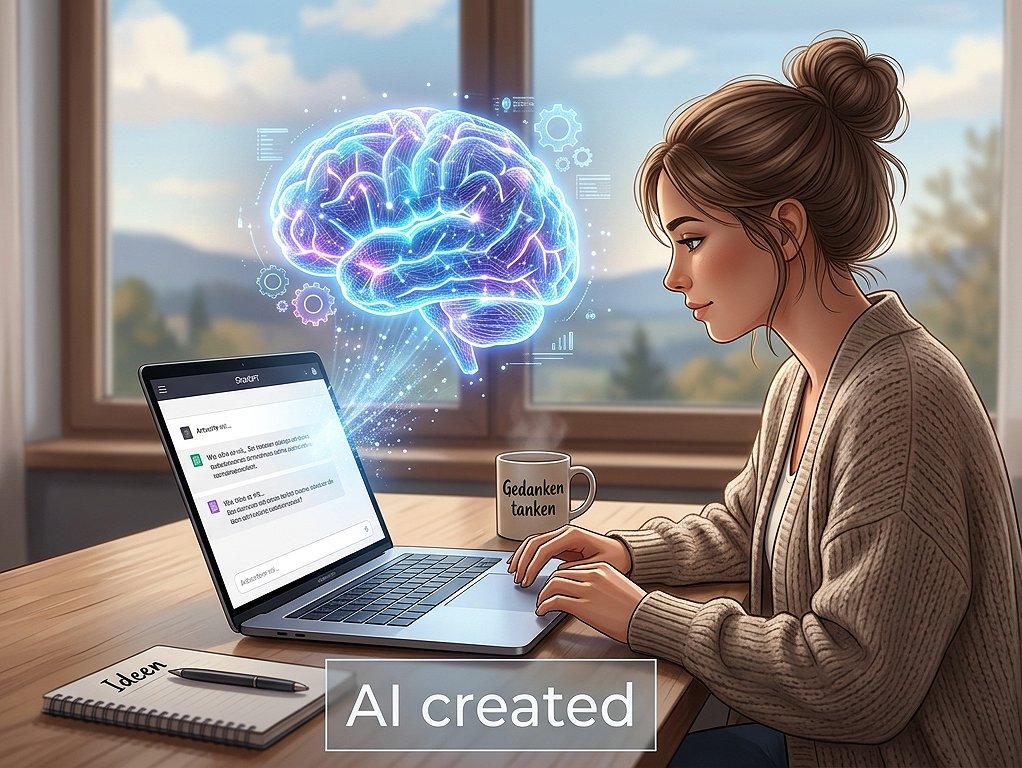
ChatGPT makes me lazy: 5 rules so AI doesn’t replace your thinking
“I can’t think for myself anymore,” writes a 19-year-old user in a Reddit forum about her ChatGPT use. She does all writing tasks with AI and is therefore losing the ability to think critically[citation:2].
This experience is not an isolated case. Studies show a clear negative correlation between intensive AI use and critical thinking skills[citation:1][citation:9]. Especially young users reportedly lose problem-solving competence[citation:1]. The good news: it’s up to you whether AI makes you “dumber” or smarter. With the right rules, ChatGPT becomes a thinking partner, not a substitute for thinking.
The problem: cognitive laziness is real
Research is clear: those who outsource thinking tasks to AI train their own brain less. Neuroscientist Lutz Jäncke compares critical thinking to a muscle: “Children and adolescents have to train it to become good at it. And adults also need to practice it regularly, otherwise they lose it.”[citation:2]
A study at MIT showed that ChatGPT users process information more superficially, exert less effort, and forget learned material faster. Brain activity was highest in users without technical aids[citation:2].
Particularly alarming: 83 percent of ChatGPT users could not recall important points from their own essays – a phenomenon researchers call “cognitive debt”[citation:9]. Those who rely too much on AI offload not only work but also thinking processes that are crucial for lasting learning[citation:5].
| Study | Result |
|---|---|
| MIT Media Lab (2025) | 83% of ChatGPT users do not remember their own essay contents[citation:9] |
| Carnegie Mellon & Microsoft (2025) | AI use reduces problem-solving skills[citation:1] |
| University of Pennsylvania (2025) | ChatGPT users give worse advice than Google users[citation:2] |
| Fan et al. (2024) | AI users show “metacognitive laziness” – less self-reflection[citation:5][citation:9] |
The good news: The effect depends on how you use AI. ChatGPT itself says: “It depends on whether we use it as a crutch or as a tool for growth.”[citation:7]
5 rules so AI doesn’t replace your thinking
Rule 1: Think first – then ask the AI
The “sandwich principle” from AI expert Simone Ries: first think, then prompt, then think again[citation:3]. If you want to write a report, first draft your own structure. Treat the AI output like a second opinion that you compare with your own proposal[citation:3].
Why it works: Your brain stays active. You train structuring and critical thinking – and use AI to improve, not replace.
Rule 2: Let it ask you questions – not give answers
Advait Sarkar, lecturer at the University of Cambridge and Microsoft researcher, says: “When the AI asks questions instead of only providing answers, it can improve our logical judgment.”[citation:3]
Use the “Study Mode” in ChatGPT. It turns the answer machine into a tutor that guides you to independent thinking through questions – instead of serving the solution on a silver platter[citation:4][citation:8][citation:12].
Activate it like this: Type / in the chat and select “Study and learn” from the menu. The mode asks you interactive questions, breaks complex topics into steps and checks whether you really understood it[citation:4][citation:8].
Rule 3: Write down your thoughts – and have AI challenge them
AI expert Joffrey Berti recommends seven “Sharp Thinking Prompts” that sharpen your thinking instead of replacing it[citation:6]. The idea: You write down your thoughts first. Then you let the AI scrutinize them.
Here are the three most effective ones[citation:6]:
- “Assumption Detector”: “Here is my opinion: [insert]. What hidden assumptions am I making? Which are risky? Explain why.”
- “Devil’s Advocate”: “Here is my plan: [insert]. Argue against it like a brutal critic. What would a skeptic call wrong, unrealistic or missing?”
- “Bias & Blind Spot Scan”: “I strongly believe in: [insert]. What biases or blind spots could shape this viewpoint?”
Why this works: You remain the thinker. AI becomes a sparring partner that sharpens your arguments – not a replacement for your thoughts[citation:6].
Rule 4: Compare multiple AI answers
Have multiple versions of an answer generated and compare them with each other. Comparing and judging already activates critical thinking, according to Sarkar[citation:3].
How to do it: Ask ChatGPT: “Give me three different perspectives on this topic” or “How would different experts answer this question?”. Compare the answers, question contradictions and form your own opinion.
Rule 5: Use AI only for the “grunge work” – not for thinking
A Harvard lecturer puts it this way: “If AI saves you time on the grunge work so you can use that time for more serious learning, that’s a plus.” But: if you use AI to do the work for you, not with you, no learning takes place[citation:7].
Allowed: AI for research, summarizing background information, proofreading, brainstorming ideas.
Not allowed: AI for fully drafting texts, solving thinking tasks without your own reflection, replacing your own argumentation.
Practice block: Your start to healthy AI use
The transition is simple. Here is your step-by-step guide for tomorrow:
- Start with your own thought sketch: Before you open ChatGPT, write down your initial thoughts on a topic – bullet points, structure, first arguments.
- Use Study Mode: Activate
/ Study and learnfor learning tasks. Let it ask you questions, not give answers[citation:4][citation:8]. - Ask sharpening questions: Use one of the “Sharp Thinking Prompts” – for example “What are the hidden assumptions in my argument?”[citation:6]
- Revise the AI output yourself: Take the AI response as raw material, but thoroughly revise it – in your own words, your own structure[citation:7].
Important: The 5 rules are not a constraint but an invitation to use AI more intelligently. Those who follow them remain masters of their own mind – and still benefit from AI's efficiency.
Conclusion: AI doesn't make you dumb – careless use can
Research is clear: AI can undermine our thinking – or improve it. It depends on us[citation:3][citation:10]. Neurobiologist Bernd Hufnagl says: “I believe that with the use of ChatGPT a gap will open. The lazy and the stupid will become lazier and stupider; the enthusiastic will become even smarter.”[citation:10]
With the 5 rules you belong to the second group. Use AI as a sparring partner, not a substitute for thinking. Then you'll not only become more efficient – you'll also stay mentally fit.
FAQ: Common questions about AI and thinking ability
Does ChatGPT really make me dumber?
Not necessarily. Studies show that careless use can weaken critical thinking[citation:1][citation:5]. But those who use AI actively and reflectively – for example as a sparring partner – can even improve their thinking ability[citation:3].
What is “cognitive laziness”?
The term describes the tendency to outsource thinking processes to AI instead of thinking for yourself. A study by the University of Teacher Education Bern shows that AI users perform metacognitive thinking processes less often – they leave many decisions to the AI[citation:5].
How do I enable Study Mode in ChatGPT?
Type / in the chat field and select “Study and learn” from the menu. The mode asks you interactive questions, breaks complex topics into steps, and checks your understanding[citation:4][citation:8].
Which prompts promote critical thinking?
Particularly effective are the “Assumption Detector” (“What hidden assumptions am I making?”), “Devil’s Advocate” (“Argue against my plan”) and “Bias & Blind Spot Scan” (“What biases could shape my view?”)[citation:6].
Can I use ChatGPT for learning without becoming dumb?
Yes – with the right method. Use Study Mode, write down your thoughts yourself first, and have the AI ask you questions instead of providing answers[citation:3][citation:4]. That way you actively train your thinking while still benefiting from the AI.



Interessanter Punkt mit der Studie vom MIT, aber vielleicht liegt das Problem eher an schlechter Nutzung von ChatGPT als an der Technik selbst, mehr Anleitung statt Verteufelung fände ich sinnvoll.
Stimmt, Anleitung hilft enorm, bei mir hat der Kommentar gezeigt wie ich Prompts klarer schreibe und dadurch viel bessere Antworten kriege. 😊