
Two Headlines, Two Worlds: What the Job Numbers 2026 Really Show
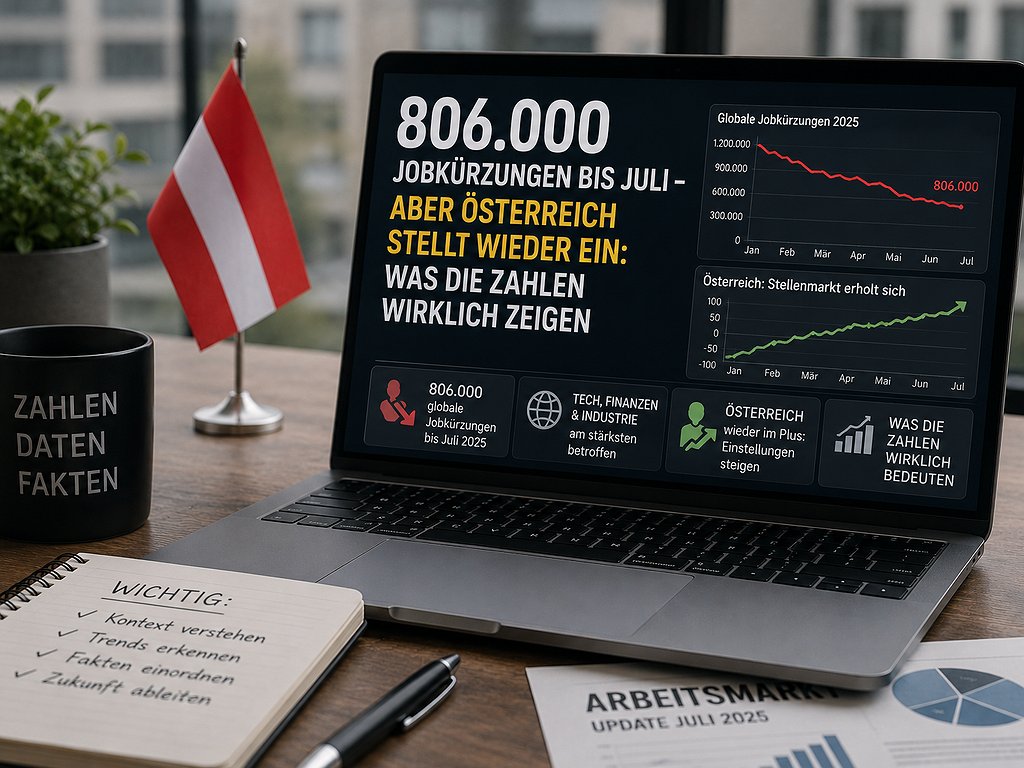
The number sounds dramatic: 806,000 job cuts announced by US companies by July 2026 – the highest value for this period since 2020. Over 10,000 lost jobs were added alone in July due to increased use of generative AI technologies. New labor market data also show: In July, only 73,000 new jobs were created in the US – far fewer than economists had expected.
At the same time, a surprisingly different picture is emerging in Austria: According to the current Stepstone survey, only 10 percent of companies plan job cuts in the next six months – while 19 percent want to hire more than they do now. How do these two realities fit together? And what does that mean for your own career planning when you navigate between alarming US headlines and the local DACH reality?
1. The US Numbers in Detail
| Indicator | Value (July 2026) |
|---|---|
| Total job cuts (Jan–Jul) | 806,000+ – highest value since 2020 |
| Tech sector cuts (Q1 2026) | 52,050 – 40% more than the previous year |
| Direct AI-related cuts (July) | 10,000+ |
| New jobs (July, actual) | 73,000 (expectation far higher) |
| Retail cuts (Jan–Jul) | 80,000+ – increase of ~250% |
| Logistics/Transport (2 weeks) | 1,222 cuts + several insolvencies |
Well-known cases: Block (Jack Dorsey) cut around 40 percent of its workforce (about 4,000 jobs), partly with explicit AI justification. Amazon eliminated 16,000 corporate jobs in January, following 14,000 in the previous autumn. Meta reportedly planned a 20 percent job cut (~15,000). Dell reduced 11,000 jobs in the first quarter – the largest single item. Salesforce cut 4,000 customer service roles, Workday 1,750 positions.
2. Why Austria (so far) looks different
The Stepstone labor market data for Austria paint a much calmer picture:
- Unemployment rate: around 7 percent – risen since 2023, but stable, no collapse.
- Job cut plans: Only 1 in 10 companies plans to cut jobs in the next 6 months.
- Hiring plans: 19 percent of companies want to hire more than previously.
- Lack of skilled workers remains main problem: 82 percent of HR managers report not being able to find suitable candidates – not too many applicants, but too few with the right skills.
- Time-to-Hire: average 6 weeks, up to 8 weeks in large corporations.
The Stepstone economist Julius Probst describes the situation as follows: „Three years of stagnation are coming to an end." Austria's economy had weakened parallel to Germany's industrial crisis – with shrinking GDP in 2023 and 2024. However, economists expect a slight growth in 2026.
3. Why the two pictures are not contradictory
At first glance, it seems paradoxical: dramatic US job cuts, stable situation in Austria. A closer look reveals four explanations:
a) Different economic structure
The US job cuts are strongly concentrated on Big Tech, Retail, and Logistics – sectors that are disproportionately large in the US. Austria's economy is more strongly influenced by industry, public service, tourism, and small and medium-sized enterprises – areas that are less affected by AI automation so far.
b) Different dismissal protection
US companies can cut thousands of jobs within days. In Austria (and DACH in general), longer notice periods, social plans, and co-determination rights significantly slow down the process. This does not mean that similar pressure does not exist – but it releases itself more slowly and less visibly.
c) „AI Washing" distorts the US numbers
A growing discourse (see Alliance for Secure AI and their new tracking platform JobLoss.ai) shows: Not every job cut declared as „AI-related" is actually primarily caused by AI. Some companies use the term as a convenient explanation for cuts that are actually related to overcapacity from the post-corona adjustment wave in 2021/22.
d) Austria is not immune – just delayed
Important: „Currently stable" does not mean „durable protected". The skilled workforce shortage situation in Austria can change quickly if AI tools become more mature and are used more strongly in small and medium-sized enterprises and the public sector. The delay compared to the US is often 12-24 months historically.
Praxis-Block: How you can correctly classify the headlines for your own planning
Large international numbers are important, but they say little about your individual situation. So go ahead:
- Separate industry from headline: A „806,000 jobs gone"-headline is usually focused on Tech, Retail, and Logistics. If you work in industry, public service, health, or craftsmanship, the direct relevance is often lower.
- Check your industry in Austria specifically: The 82-percent mismatch figure shows: The actual bottleneck is often not „too many applicants," but „too few with the right skills". Ask yourself: Do I have the skills currently being sought?
- Observe recruitment signals in your target company: Job ad volume, LinkedIn activity from recruiters, press releases about investments or expansion. Individual company signals beat global headlines.
- Use the current willingness to switch strategically: According to Stepstone, every second employee plans a job change in 2026. This increases movement in the market – for you a chance if you are well prepared.
- Build skills that close the skilled workforce mismatch: If 82 percent of companies cannot find suitable candidates, the question is not „are there jobs?" but „am I the right candidate".
4. What you should learn from both realities
The actual insight from the number comparison is not „USA bad, Austria good" or vice versa. It is: Global headlines and local reality can be significantly different – and both are true at the same time.
=== ÜBERSetzter HTML ===For your career planning, this means: don't let dramatic US numbers get you into a state of panic if your specific situation in Austria or Germany looks different. But don't ignore the signals completely either – the trend towards more AI automation is real and will eventually reach DACH with a delay. The best strategy is a mix of calmness towards panic headlines and active preparation for structural change.
5. Conclusion: navigating between headlines and your own reality
806,000 job cuts are a real and serious number – but it's a US number, shaped by a different economic structure and labor law system than in Austria. At the same time, the 82% skill mismatch in Austria shows: the real success factor isn't whether the job market is growing or shrinking overall, but whether you have the skills that are currently in demand.
That's where Skill Tandem comes in. On our platform, you'll find learning partners and mentors who will help you build the skills that close the skill mismatch on your side. Whether it's languages, digital competences, or specialist knowledge – learning together will get you there faster, where the market needs you. Sign up free now and start with a learning partner!
FAQ: Frequently Asked Questions about job numbers 2026
Are the 806,000 job cuts really all caused by AI?
No. AI is mentioned as one of the top 5 reasons, but by far not the only one. Trade policy, wage insecurity, post-Corona overcapacity, and economic cooling also play a big role. The new platform JobLoss.ai tries to distinguish between "explicitly AI-related", "suspected AI-related", and "mixed reasons".
Does Austria's stable situation mean I don't have to worry?
Not quite. Stable doesn't mean unchangeable. The delay between US trends and DACH effects is often 1-2 years historically. Active skill development remains sensible, regardless of the current stability.
Which sectors in Austria are most affected by the skill shortage?
According to current data, IT, care, crafts, and technical professions are most affected. The 6-8 week time-to-hire at larger companies shows how hard it is to find suitable candidates.
What is "AI Washing" exactly?
The term describes the practice of citing AI as the reason for layoffs, when the actual reasons lie elsewhere (cost pressure, overcapacity, restructuring). It makes layoffs appear more modern and less negative on the outside, but distorts public perception of the actual AI impact.
How can I best prepare for a possible job change in 2026?
Since, according to Stepstone, every second employee plans to change jobs in 2026, the market is in motion. Use this to your advantage: build skills that are currently in demand, keep your network active, and observe concrete signals in your target industry rather than just global headlines. A Tandem partner on Skill Tandem will help you work on the right skills with support.



Hab selbst schon Erfahrungen mit Jobkürzungen gemacht, weil mein alter Chef auch mit KI-Technologien gearbeitet hat und dann einige Stellen abgebaut hat