
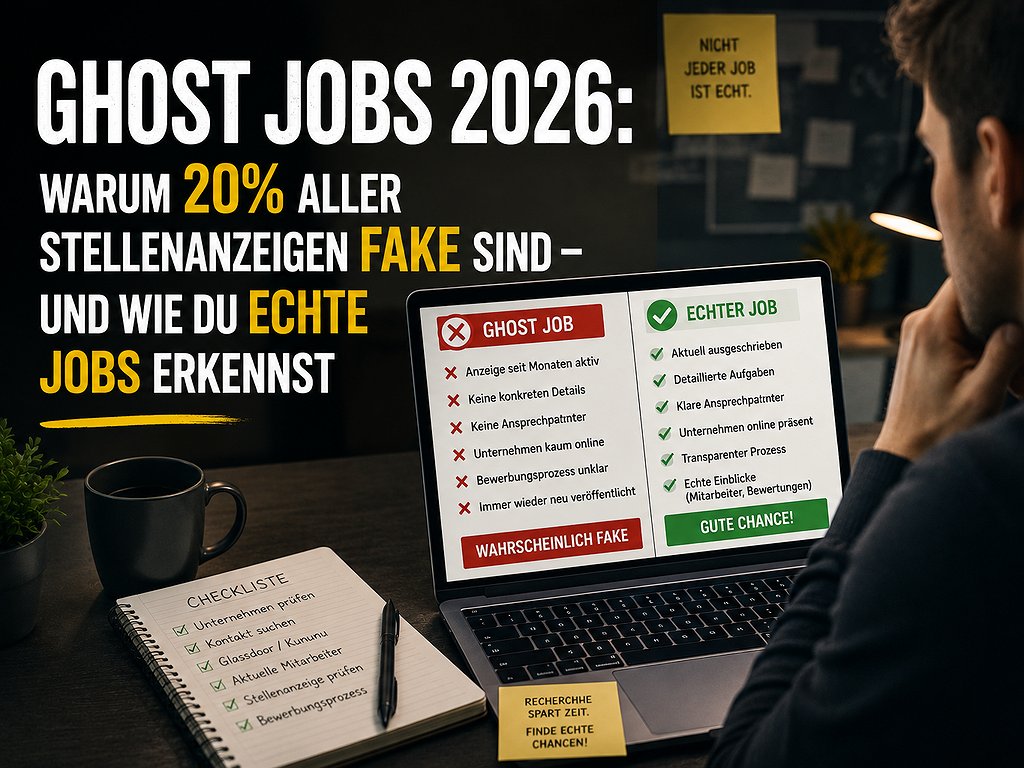
Ghost Jobs: When Job Advertisements Are Not Jobs
You see the perfect job. Exactly your profile, fair salary, exciting company. You polish your resume, tweak the cover letter, and hit send – and never hear back. No "thank you, not interested." No "currently no capacity." Just radio silence.
Congratulations, you've encountered a Ghost Job – a job advertisement that either doesn't intend to be filled, is already filled, or is only online for marketing purposes. Studies estimate that up to 20% of online job advertisements in 2026 fall into this category. In some industries (tech, consulting, marketing) even more.
This article shows you why Ghost Jobs exist, how to spot them, and how to adjust your job application strategy so you don't waste your energy on black holes.
1. Why Do Companies Post Ghost Jobs?
Most people think every job advertisement corresponds to an actual open position. That was once true. In 2026, companies have at least five reasons to post job advertisements that no one intends to fill:
1. Build Talent Pipeline (for later)
HR departments build a database of candidates in case someone leaves. Your application lands in a folder. Maybe someone gets in touch in 8 months. Usually, no one does.
2. Signaling Effect Outside (we're growing)
Startups and scale-ups use job advertisements as indirect PR: "We have 40 open positions" sounds good for investors, the press, and potential customers – even if only 8 are actively being filled.
3. Internal Pressure due to Processes
Many companies have to externally advertise jobs due to regulatory requirements, even if the position has already been allocated internally. This is particularly common in corporations and public administrations.
4. Market Pressure on Existing Employees
If job advertisements for similar roles are publicly visible, implicit pressure is exerted on existing team members: "You're replaceable." A calculated cold management tactic.
5. Salary Benchmarking
Some companies post jobs to see what salary demands the market has – without any intention to hire.
2. The 8 Clear Signs of a Ghost Job
No single sign is a 100% proof. But if you see two or more of these patterns, be cautious:
1. The advertisement is over 60 days old
Active job postings are usually filled or extended (with date adjustment) within 30-45 days. An advertisement that has been online for three months without change is suspicious.
2. No Contact Person with a Name
"Please apply through our portal" without any named contact person is a warning sign. Serious recruitment typically has at least one named recruiter or hiring manager.
3. Extremely Broad Job Requirements
If the job requires "Senior Developer, but also marketing understanding, experience in sales, and preferably UX knowledge," it's often a wish list without actual priorities. Super-profile advertisements ("We're looking for the perfect candidate") can also be Ghost Jobs.
4. No Response to Targeted Inquiries
If you contact the recruiter by email or LinkedIn and don't receive a response within 5 working days, the likelihood of the job not being actively filled is high.
5. The Company Had Recent Layoffs
If a company laid off 500 people last month and is now advertising 30 jobs – be cautious. This combination is often a PR move, not an actual hiring effort.
6. Extremely Generic Description
... === ÜBERSetzter HTML-Abschnitt ===
"We are a dynamic team working on exciting projects and looking for someone to join us." Without concrete tasks, without concrete success metrics, without a concrete tech stack. This is boilerplate text.
7. Ad is running in parallel on 5+ platforms
Serious job postings usually run on 1-2 targeted channels. Ghost Jobs are often posted everywhere to collect reach and applicant data.
8. No "Why this role now?"
Real job postings usually explain why the position exists now: growth, new location, predecessor is on parental leave. Ghost Jobs avoid this context information.
Praxis-Block: The 5-Minute Ghost Job Check Before Every Application
Before you invest an hour in an application, do this quick check:
- Check the date: When was the ad posted? Often visible on LinkedIn and XING. Anything over 60 days: skepticism.
- Search for the team on LinkedIn: Search for "Hiring Manager" or similar roles in the company. Are there active recruiters for the department? If not, suspicious.
- Check company news in the last 90 days: Google "[Company] layoffs 2026" or "[Company] layoffs 2026". If there was recently a personnel cut – be cautious.
- Test personal contact: Before the official application, send a brief, friendly LinkedIn message to a team member: "Hi, I saw the role X and am very interested – is the role still active?" If no response after 5 days, you know.
- Set a budget for applications: Maximum 30 minutes for a first application. If you notice you're spending 2 hours on a cover letter, although the ad has Ghost Job characteristics – stop.
3. The new application strategy: Fewer applications, better chances
The classic approach "30 applications per week" does not work anymore in 2026. What works:
1. Direct contact before application
Research the hiring manager on LinkedIn, send a brief, valuable message. If you get a response, you know: The role is real. If not, save yourself the application.
2. Network-based applications
Studies show consistently: Over 70% of positions are never filled publicly or given through recommendations. Time you invest in Ghost Job applications would be better invested in network building.
3. Precision instead of shotgun
10 high-quality, tailored applications per month beat 50 mass applications. Always.
4. Info conversations instead of applications
A "coffee conversation" with someone in the target position/company often brings more than an application. You learn if open positions are real – and become the person remembered.
4. Why job search 2026 is mainly a networking question
The Ghost Job boom is only a symptom of a larger shift: The official application process through portals is becoming increasingly unreliable. AI filters, generic job postings, endless applicant masses – all this makes traditional applications a game of chance.
At the same time, one thing is gaining immense value: Direct, personal relationships with people who can recommend or inform you. Who in 2026 cultivates an active network has a fundamental advantage.
=== ÜBERSETZTER HTML ===That's exactly where Skill Tandem comes in. On our platform, you regularly learn from other people in your field – not as a classic networking event, but through genuine knowledge exchange. That creates the strongest connections: people who know you in action, who can recommend you, and who can give you real insider information about jobs that never appear in an ad. Sign up for free now and strengthen your professional network!
FAQ: Frequently Asked Questions about Ghost Jobs
Are Ghost Jobs illegal?
No, in most countries, it is legally permissible to post job ads without a concrete staffing plan. However, in Germany and Austria, there are gray areas in labor law if ads are intentionally used for market observation without hiring. Legal consequences are rare, though.
Which industries have the most Ghost Jobs?
Technology, consulting, and marketing are particularly affected. Even startups in the fundraising phase often post "growth ads" that are not seriously filled. Less affected are crafts, care, and education.
Should I report firms with Ghost Jobs or boycott them?
You can report them to the portals (LinkedIn, XING), which are increasingly reacting. Boycotting is difficult because many companies are not intentionally posting Ghost Jobs – often, it's internal HR processes. Focus on your own job application strategy instead.
How many job applications should I realistically write per week?
Quality over quantity. 5-8 well-researched, personalized job applications per week with prior LinkedIn contact are better than 30 mass applications. Plan 2-3 informational interviews per week in parallel.
Are there tools that can automatically detect Ghost Jobs?
Initial browser extensions and job boards are experimenting, but detection is still unreliable. The best filter remains manual review with the signs from this article.
What to do if I notice I've written many Ghost Job applications?
Don't get frustrated, but rather adjust your approach: reduce the number of applications, invest the free time in your network and skills development. A Skill Tandem learning partner is actually an excellent way to learn and meet people who can help you with your job search.




Ich nutze eine To-Do-Liste, um meine Bewerbungen zu organisieren, hilft mir dabei, Zeit zu sparen!