The New Two-Tier Career 2026: Why Some Jobs Grow 42% Faster Than Others – And Where You Stand
On June 15, 2026, PwC published the Global AI Jobs Barometer 2026 – one of the most comprehensive analyses of the KI effect on the labor market so far. Over one billion job postings from 27 countries were evaluated. The result is a clear diagnosis: The labor market is splitting into two completely different classes of jobs. And the difference is getting bigger month by month.
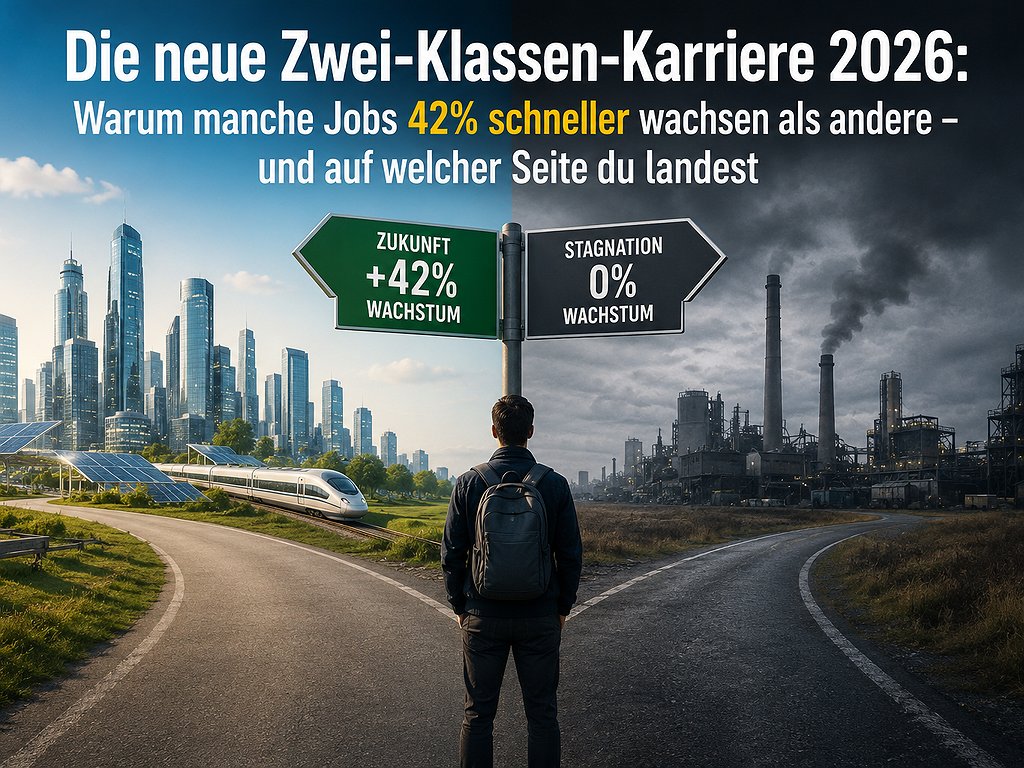
One class: "professionalized" roles, where KI takes over routine tasks and human expertise becomes more important. The other: "democratized" roles, where KI simplifies the task to the point where non-experts can do it. The former are growing twice as fast in job postings and salaries there are increasing 42% faster. It's time to find out which side your job is on – and what you can do if you want to switch.
1. What Does "Professionalized" vs. "Democratized" Mean?
“Professionalized” Jobs: KI Raises the Bar
Here, KI takes over repetitive routine tasks while humans are needed for judgment, experience, and responsibility. Examples from the PwC report:
- Radiologists: KI detects abnormalities in images in seconds. Humans decide on diagnosis, speak with patients, and are responsible for the overall picture.
- Recruiters: KI screens 1,000 resumes per hour. Humans conduct interviews, read between the lines, and decide on cultural fit.
- Lawyers: KI quickly searches precedents. Humans develop strategy, negotiate, and convince judges.
- Software Architects: KI writes boilerplate code. Humans design systems, make trade-off decisions, and lead teams.
“Democratized” Jobs: KI Makes the Role Accessible to All
Here, KI lowers the barrier so much that the role no longer requires specialized knowledge. Examples:
- IT Service Managers: Many tasks (ticketing, documentation, standard support) can now be handled by employees without IT training, thanks to KI.
- Medical Administrative Assistants in certain administrative roles: Scheduling, documentation, and simple queries are increasingly automated.
- Junior Content Creators: If anyone can create a decent blog post with KI, the market value of classic junior copywriters decreases.
- Basic Translators: For standard texts, KI is often sufficient today – the field shifts to localization and specialized translation.
Important: "Democratized" is not bad. These roles will not disappear completely – they will become more common, cheaper, and less specialized. But career prospects, salaries, and growth opportunities are measurably worse.
2. The Hard Numbers from the Report
What the PwC report shows in concrete terms:
- Job growth: Professionalized roles grow twice as fast as democratized ones.
- Salary growth: +42% faster salary growth in professionalized roles.
- Skills: The most in-demand skills are judgment, creativity, leadership – all genuine human abilities.
- Company level: Companies that use KI intensively are hiring faster than the rest of the market. The advantage does not go to KI – it goes to the humans running KI companies. Register now and gain access to Skill Tandem to take the first step towards a successful career in the new two-tier career landscape.
- Newcomer: Die Anforderungen an Junior-Positionen in KI-exponierten Bereichen verändern sich massiv. Ausführungsfertigkeiten treten zurück, Analyse-, Kommunikations- und Bewertungsfertigkeiten treten vor.
3. On which side are you? The 5-question-test
Beantworte diese Fragen ehrlich für deinen aktuellen Job:
- Wie viel deiner Arbeit ist wiederholte Ausführung nach klarem Muster? (Über 60% = Warnzeichen)
- Trifft du regelmäßig Entscheidungen unter Unsicherheit, bei denen es kein klares „richtig" gibt? (Je häufiger, desto professionalisierter)
- Bist du für ein Ergebnis verantwortlich, das sich nicht in einer einzelnen Kennzahl messen lässt? (Ja = professionalisiert)
- Musst du in deinem Job Menschen überzeugen, führen, koordinieren oder trösten? (Ja = professionalisiert)
- Könnte man deine Rolle einer Person ohne dein Fachwissen übertragen, wenn diese Person Zugang zu guter KI hätte? (Ja = demokratisiert)
Result: Wenn du bei 3+ Fragen zur professionalisierten Seite tendierst, bist du in der wachsenden Gruppe. Wenn du bei 3+ zur demokratisierten Seite tendierst, ist es Zeit, aktiv gegenzusteuern.
Praxis-Block: How to switch to the professionalized side
You're not stuck in your job category. Even within the same job title, there are usually a professionalized and a democratized path. This is how you can design your switch:
- Build your decision-making skills: Take on tasks where it's not just about „right or wrong", but about weighing. Find situations where you have to decide – and document your decision-making processes.
- Become a KI supervisor: Instead of fighting against KI, position yourself as someone who reviews, curates, and is accountable for KI output. „AI Supervisor" is one of the fastest-growing job types 2026.
- Invest in human skills: Negotiation, de-escalation, empathy, complex communication. Exactly these are according to PwC the most strongly growing requirements. A Tandem partner is ideal to train these skills specifically.
- Become a Domain Expert: Deep, specialized knowledge in a specific field (medicine, law, finance, industry sector X) is worth more than ever. Domain knowledge is the best KI buffer.
- Take responsibility visibly: Lead projects, present results, take responsibility for decisions. Those who only execute, without responsibility, will automatically be on the democratized side.
4. What makes the DACH region special
Germany, Austria, and Switzerland have structural peculiarities that color the PwC analysis additionally:
Dual education as an advantage
Trades, technician, and vocational training with dual education are often automatically professionalized: They combine expertise with responsibility. Exactly the sweet spot.
Skilled labor shortage creates room for negotiation
In nursing, crafts, IT, and education, demand is still higher than supply. Those who take on professionalized roles here have an extremely strong negotiating package.
But: Bureaucracy can extend democratized roles
Many administrative roles in the public sector and in corporations are highly democratizable – here the change will probably be slower, but unstoppable. Time to plan actively.
5. Conclusion: Career success 2026 is a conscious decision
The PwC report makes one thing clear: the choice between a professionalized and democratized career is rarely made consciously – but it is the most important career decision of this decade. Those who let themselves be carried away often end up on the democratized side. Those who actively steer themselves come into the professionalized group.
The most important lever is consistent skill development – and that's not just in pure tool skills (which quickly become outdated), but in human meta-skills: judgment, complex communication, negotiation, and expertise.
Skill Tandem is exactly tailored to this. On our platform, you'll find people with whom you can develop these meta-skills together – in real exchange, not just in online courses. A tandem partner will help you negotiate in a language, deepen a subject, or train your communication strength. This way, you'll move step by step to the growing side of the job market. Sign up for free now and actively shape your career position!
FAQ: Frequently Asked Questions about the Two-Track Career
Are "democratized" jobs bad?
No, not bad – but less growth-oriented. A job can be meaningful, fulfilling, and valuable without being in the professionalized category. What's important is that you make the decision consciously and adjust your expectations regarding salary and career development accordingly.
Do I need to switch to a completely new profession?
Not usually. Within almost every profession, there are both professionalized and democratized positions. A graphic designer can develop corporate brand identity (professionalized) or fill in standard templates (democratized). The switch within the field is often possible.
Which skills are most important according to PwC?
The report names three consistently: judgment („judgment"), creativity, and leadership. All three are trainable – best in real situations with feedback from other people, not in pure courses.
How long does this take?
Realistically: 12-24 months for a noticeable change within a profession, if you consistently work on skills and positioning. Longer if you switch to a completely new field.
What if my current employer won't develop me in that direction?
That's a strong signal. If your environment keeps you in a democratized execution, despite your desire to grow, that's a good reason to change employers – or at least switch departments. Waiting will cost more, the longer you wait.
How does a learning partner help me concretely?
A tandem partner creates real conversation and practice situations for exactly the skills that count: argumentation, negotiation, language skills, and expertise depth. No course can replace real face-to-face interaction. That's why tandem learning 2026 is one of the strongest levers for transitioning to the professionalized career class.


Ich wuerde mich interessieren ob es wissenschaftliche Belege fuer diese Aussagen gibt