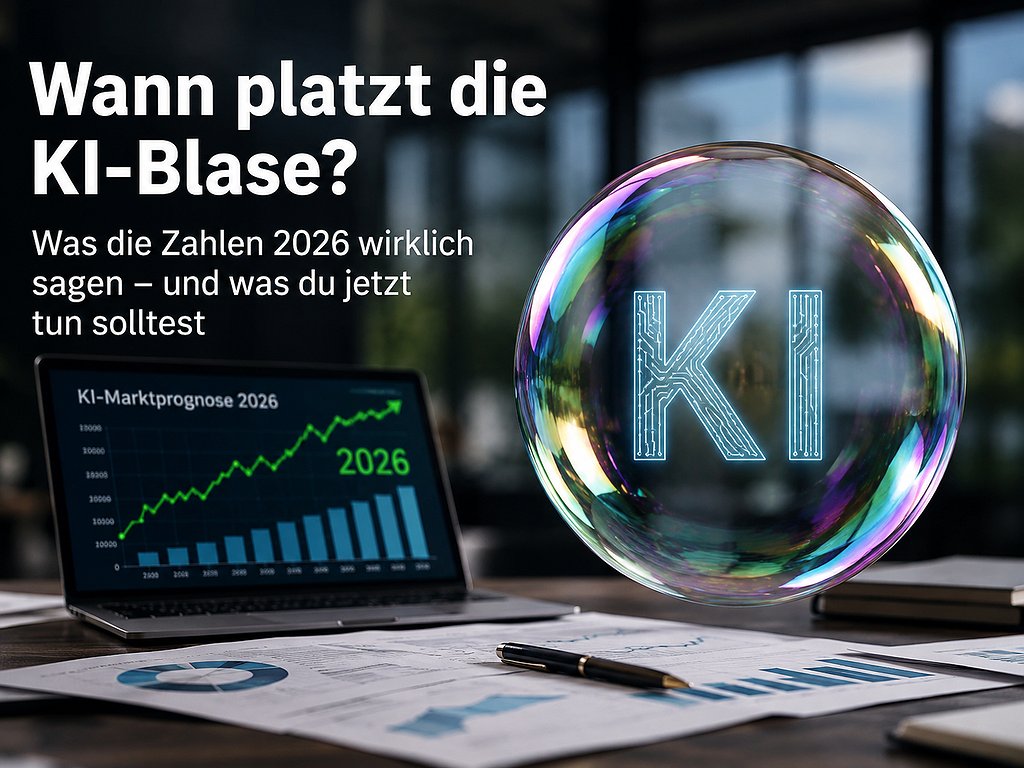
When Will the AI Bubble Burst? What the Numbers 2026 Really Say – and What You Should Do Now
For the past three years, the same headlines have been making the rounds in the media: "The AI bubble will burst." And for the past three years, the AI industry has been there the next day – bigger, more expensive, and more contentious. But something has changed in June 2026. The mood is shifting. Some software stocks have plummeted, cheap competition from China is putting pressure on prices, and even the IMF and major investment banks are speaking out about when things will get serious.
In this article, you'll get: the most important numbers as of 2026, three realistic scenarios, what top investors are really saying – and most importantly: what you can learn from it for your career, learning, and next steps.
1. What does "AI bubble" even mean?
A speculative bubble forms when the prices of assets – stocks, company shares, valuations – rise much faster than the underlying economic value. Classic examples are the tulip mania in the 17th century or the dot-com bubble around 2000.
With AI, it's specifically about three areas that are all hot at the same time:
- AI company valuations: OpenAI, Anthropic, Mistral, xAI, and hundreds of startups.
- Infrastructure investments: data centers, NVIDIA chips, cloud capacity.
- Big Tech stocks: Microsoft, Google, Amazon, Meta, NVIDIA – the so-called "Magnificent 7".
If just one of these areas starts to falter, it can pull the whole system down. That's what's making people nervous in 2026.
2. The numbers that are making everyone nervous
Here are a few key data points as of June 2026, so you can understand the scale:
- OpenAI is now valued at around $730 billion – up from $500 billion just a few months ago.
- There are currently around 498 AI unicorns (startups valued at over $1 billion) with a combined valuation of $2.7 trillion.
- Goldman Sachs has increased its estimated AI investments for 2026 from $465 billion to $527 billion.
- DeepSeek from China offers models that, according to the provider, are around 34 times cheaper than GPT-5.5 – with comparable quality in many tasks.
- Salesforce and ServiceNow have each lost around 30 percent of their value since the start of the year – aka "SaaSpocalypse": investors are worried that AI agents will make traditional software obsolete.
- NVIDIA has a price-to-sales ratio of over 30 – historically a warning sign.
Meanwhile, the industry is closely intertwined: NVIDIA invests in OpenAI, OpenAI rents computing power from Microsoft and Oracle, Microsoft buys chips from NVIDIA – observers call it "circular financing". Critics say that a lot of money is just circling around, ignoring real growth.
3. Three scenarios: How things could go from 2026 to 2028
Scenario 1: Soft correction (most likely scenario)
The valuations will be brought back down to more realistic levels over 12 to 24 months. For example, NVIDIA's price-to-earnings ratio will fall to 25-35 (from its current 60+). There will be some painful quarters, but no total crash. Similar to when actual demand meets overly optimistic expectations in the classic "Slope of Enlightenment". Many analysts think this is the most likely scenario.
Scenario 2: Startup meltdown (very likely)
Several market analysts estimate that 50 to 70 percent of AI startups will disappear or be acquired by 2028 – similar to what happened after the dot-com bubble. Only the top 5 players (OpenAI, Anthropic, Google DeepMind, xAI, Mistral) will remain, with the rest consolidating. For employees and job seekers, this means: risk at small AI startups, stability with established players and their clients.
Scenario 3: Systemic crash (possible, but unlikely)
If a major player like OpenAI gets into serious trouble, it could trigger a chain reaction: write-downs at Microsoft and NVIDIA, pressure on cloud providers, plummeting tech stocks. The International Monetary Fund warned in the spring of 2026 that a burst was possible – but "not systemically destructive" like the 2008 financial crisis. That's some comfort. But only some.
4. What are the most important voices saying?
What's interesting is that the camps are becoming more distinct in 2026:
- JPMorgan found in a December 2025 analysis that the AI rally shows "structural usefulness" – real economic value – and not just speculation.
- Howard Marks (Oaktree Capital), one of the most respected voices, says: "The valuations are high, but not crazy." He sees no mass hysteria yet.
- Fed Chairman Jerome Powell has explicitly distinguished the current environment from the dot-com bubble.
- On the other hand, tech critics like Ed Zeevin and analysts like Edward Yardeni are warning of overheating – especially due to circular financing and the high concentration in the market.
- Wagering markets like Polymarket currently see a two-digit probability for a sector downturn within the next few months – no consensus, but no longer a fringe topic.
Simply put: no one can predict the timing. But almost all serious analysts see 2026 to 2028 as the "window with the highest correction risk".
Praxis-Block: What does this mean for you in concrete terms?
If you're reading this now and thinking "I'm not really interested in stocks" – wait a minute. The AI bubble affects you even if you don't hold any stocks. And that's in at least four areas:
- Your employer: If your company invests heavily in AI tools and the returns don't come, costs will be cut – affecting employees.
- Your career path: Whoever bets everything on being a "prompt engineer" might have a problem in 2027. These roles are already being automated.
- Your side hustle: If you rely on a single AI provider, you're vulnerable – to price increases or bankruptcy.
- Your learning behavior: What's worth learning if AI is supposed to be able to do everything? The answer to this question decides whether you're a winner or loser in this phase.
5. Five Skills That Remain In Demand Even After the Hype
Even if the AI bubble bursts tomorrow, the technology itself will remain. But the competition will shift. These are the skills that will gain value in any scenario:
1. Connecting AI with Real Business Understanding
Those who can not only use AI tools but also integrate them into real business processes, with an understanding of customers, margins, and risks, will be in demand. This bridge between departments and technology is priceless.
2. Critical Thinking and Fact-Checking
Even in 2026, AI models will hallucinate – current top models have an over 10% hallucination rate. Those who verify sources, follow logic, and identify errors will be indispensable.
3. Communication, Negotiation, and Relationship Building
What AI can structurally struggle with: building trust, reading nuances in conversations, and defusing difficult situations. These "soft skills" are the hardest currency in the AI era.
4. Building Your Own Tools Instead of Just Consuming
With "Vibe Coding" and low-code platforms, anyone can build smaller tools and automations today. Those who master this will no longer be dependent on a single provider.
5. Lifelong Learning as a Routine
The half-life of skills is decreasing. Those who learn a new main competence every two to three years will remain adaptable – regardless of how the market changes. Learning will become the most important career insurance.
6. Conclusion: The Bubble is Not the Biggest Threat – Stagnation is
The question of when the AI bubble will burst in 2026, 2027, or 2028 is still open. What's not open is that the phase of pure euphoria is over. What remains is a slower, healthier market where not everyone will have a secure "AI job" – but people with real skills will be in greater demand.
The bad news: Those who relied only on the hype will feel it. The good news: Those who continue to learn, exchange with others, and build skills that machines cannot master will emerge from this phase stronger.
That's exactly what Skill Tandem is made for. On our platform, you'll find learning partners, mentors, and people with whom you can grow together – whether you want to learn languages, build AI skills, or develop new career competences. Learning in pairs is not only more effective, but also more crisis-resistant. Register now for free and start anew together!
FAQ: Frequently Asked Questions About the AI Bubble
When Will the AI Bubble Probably Burst?
Nobody can predict it exactly. Several analysts hold 2026 to 2028 as the time frame with the highest risk – with the IPOs of OpenAI and Anthropic, as well as the Q-reporting season, as possible triggers.
Is the AI Bubble Comparable to the Dotcom Bubble?
Partially. Both phases are characterized by high valuations and great expectations. Unlike in 2000, there are already functioning business models and real revenues today. Even the Fed Chairman has distanced himself from the comparison.
Should I Stop Learning AI Skills if the Bubble Bursts?
On the contrary. Just like the Internet did not disappear after the Dotcom crisis, AI will remain. Those who then have practical competence will benefit especially.
How Can I Protect Myself from a Correction?
Diversify your skills, do not rely on a single AI provider, build networks, and learn continuously. A broad skill base is your best insurance.
Will AI Become Cheaper or More Expensive After the Bubble Bursts?
Probably cheaper (price competition, see DeepSeek) first, then more expensive in the medium term as weaker providers exit the market and the market consolidates.



Ich kenn das Problem mit den Bewertungen von KI-Unternehmen, hab selbst bei einem Startup gearbeitet, das zu hoch bewertet wurde und dann pleiteging!