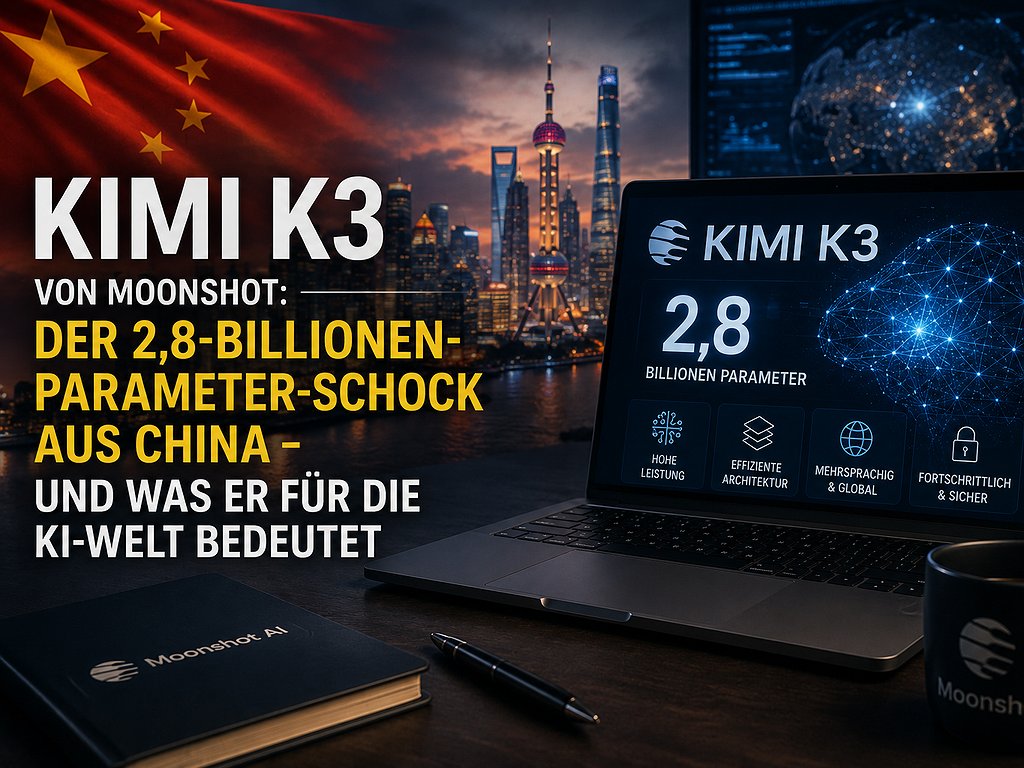
Kimi K3: The 2.8-Billion Parameter Shock That No One Saw Coming
On July 16, 2026, the Beijing-based AI startup Moonshot AI released a model that has sent the AI world into one of its rarest "wobbly moments": Kimi K3. With 2.8 billion parameters, it is the largest open-weight AI model ever released – about 75 percent larger than DeepSeeks V4 Pro and many times larger than anything previously open-sourced by Meta, Mistral, or Zhipu.
The market reaction was accordingly: TSMC lost around 7 percent on Friday, despite the company announcing a 77 percent increase in profit. SoftBank fell 9 percent, Nvidia slipped and temporarily lost its position as the world's most valuable company to Apple. The Chinese startup Z.ai plummeted almost 30 percent. Within hours, financial media were talking about a "DeepSeek Act II".
But what's really behind Kimi K3? Is this a genuine technological paradigm shift or just another chapter in the AI evaluation circus? And more importantly: What does it mean for you – as a self-learner, as a professional, as a human in an accelerating AI world?
1. The Facts About Kimi K3
The hard numbers
- 2.8 billion parameters – the largest open-weight model of all time.
- 1 million token context window – enough for entire codebases or multiple books at once.
- 21 percent fewer output tokens than the predecessor K2.6 on the same tasks – an efficiency gain.
- Multimodal: Natively understands images and visual information.
- API prices: $3 per million input tokens, $15 per million output tokens – roughly half the price of Anthropic's Claude Opus 4.8.
- Release schedule: The model is available now on kimi.com, the full weights will be open-sourced on July 27, 2026.
- OpenAI SDK compatible: Developers who already work with OpenAI or Anthropic can switch with minimal effort.
What Moonshot claims (with cautious reserve)
According to its own benchmarks, Kimi K3 is "competitive" with Anthropic's Fable 5 – the currently strongest publicly available model – and beats Opus 4.8, GPT-5.5, and GPT-5.6 Solo "significantly". An independent benchmark by Arena.AI even positioned K3 as the currently best available model overall, ahead of Anthropic. These benchmarks are self-reports – as always in the AI race, they should be read with healthy skepticism. But even if part of it is exaggeration: The distance to the US frontier has clearly narrowed.
What's behind the company
Moonshot AI was founded by Yang Zhilin, a former Google researcher, and is backed by Alibaba. The current funding round values the company at around $31.5 billion – in May, it was still $20 billion. Annual revenue exceeded the $200 million mark in April 2026, mainly through subscription and API usage. Kimi's consumer product is one of the most popular AI chatbots in China.
2. Why This is a "DeepSeek Act II" Moment
In early 2025, DeepSeek's R1 model triggered a similar shockwave at the financial markets. The reason then, just as now, is the same: A Chinese lab proves that AI frontier capabilities are no longer the exclusive domain of OpenAI, Anthropic, and Google – despite all US export controls on semiconductors and manufacturing equipment.
Three factors make Kimi K3 particularly relevant:
a) Open Weights means global availability
On July 27, 2026, the full model weights will be released. This means that every company and individual worldwide can run K3 on their own hardware – provided they have the necessary resources. For countries with strict data protection or sovereignty requirements, this is a significant gain.
b) The price pressure will be brutal
If a model with comparable performance is 50% cheaper, the price policy of US providers will come under pressure. In the coming months, price reductions at OpenAI, Anthropic, and Google are likely – good news for users, but a challenging situation for the profit margins of the providers.
c) The geopolitical dimension
Congress hearings in the US are already addressing the "gaps in export controls." But the reality is: Three years of escalating restrictions have not prevented Chinese labs from reaching the frontier – on the contrary. The strategic shift will strongly shape the next 24 months.
3. What's happening behind the scenes: Two architectural innovations
Kimi K3 is based on two technical innovations developed by Moonshot:
Kimi Delta Attention (KDA)
A hybrid linear attention mechanism that massively improves efficiency in very long contexts (1 million tokens). Classic attention mechanisms scale quadratically with context length – KDA tries to keep it linear without sacrificing quality.
Attention Residuals (AttnRes)
Described as a "drop-in replacement" for classic residual connections, with consistent scaling gains. Both techniques have already been released as open research on GitHub – a sign of Moonshot's strategic focus on open-source and scientific transparency.
For you as a user, these details are less important than the practical consequence: Kimi K3 can solve longer tasks more efficiently than its competitors. This is particularly valuable for coding, scientific research, and agentive tasks.
4. What this means for you in concrete terms
Whether Kimi K3 makes it into your daily routine or not, it's less about the technology and more about your role and your application case. Four realistic scenarios:
For self-learners and students
In the short term, not much will change for you – ChatGPT and Claude will remain available, but their prices may decrease. If you work with English and German technical texts, Kimi K3 is worth testing. In the medium term (6-12 months), the diversity of strong KI models will lead to you being able to choose providers – by price, data protection, language quality, or specialization.
For professionals in KI-related roles
The pressure to master more than one provider will increase. The skill "Multi-Model Comparison" – knowing which model is suitable for which task – will become more important than deep knowledge of a single provider. Those who today only have "ChatGPT certifications" on their CV risk being left behind.
For businesses and freelancers
Kimi K3 makes local and self-hosted KI deployment more realistic than ever. For DACH companies with data protection requirements (law firms, tax consultants, medical practices, but also classic middle-class consulting), new options will open up. The question "Can we not host it ourselves?" will become more sensible.
For everyone: The skill shift is accelerating
What it all connects is: The shift from pure tool knowledge ("I can use ChatGPT") to meta-competence ("I can choose the right KI for the right task and orchestrate it"). This is the skill that counts in 2026.
Praxis-Block: Kimi K3 in 15 Minuten selbst ausprobieren
You curious? Here's how you can try out the model without any technical expertise:
- Test it directly in your browser: Go to kimi.com and register with your email. The basic interface works similarly to ChatGPT.
- Compare to your current tool: Take a typical task you usually do with ChatGPT or Claude – for example, text summarization, programming help, or language practice. Perform the same task in Kimi K3 and honestly compare the results.
- Check the language: Kimi is a Chinese model. The German quality has improved significantly, but test it critically, especially for complex formulations and specialized terms.
- Be mindful of data protection: Everything you enter on kimi.com goes to Chinese servers. For private or non-critical tasks, that's okay. For sensitive professional data, wait for local deployments (weights available from July 27).
- For developers: The API is compatible with OpenAI-SDK. This means you can switch the endpoint with a single line of code and test Kimi K3 as a backend. Ideal for A/B comparisons in existing applications.
Important note on costs: Kimi K3 only has a reasoning mode ("max"), which leads to high token consumption. An independent tester spent around 13,000 tokens and about $0.25 on a simple SVG pelican test. For frugal applications, smaller models like Claude Haiku or GPT-5 Nano are more cost-effective.
5. The Honest Reality Check
Two truths that often get lost in the current hype:
First Truth: Benchmarks are not Reality
A model that excels on synthetic benchmarks can be worse in your actual task. This applies to Kimi K3 just like any other. Only your own testing shows whether the model fits your use case.
Second Truth: Size is not Everything
2.8 billion parameters sound impressive. However, for many everyday tasks, 100 billion parameter models with good fine-tuning are sufficient – and they are much faster and cheaper. The real competition in the next 12 months won't be among the big model champions, but among the practical usability.
What the bigger picture shows
Kimi K3 is part of a pattern that has become increasingly clear since the beginning of 2025: Frontier-KI is no longer a closed class. The gap between closed-source market leaders and open alternatives is shrinking month by month. This is good for users, but alarming for investors who bet on individual players like OpenAI or Anthropic – see the market reaction.
6. Conclusion: What Really Matters in 2026
The question of which model is currently "the best" is becoming increasingly irrelevant. Three skills are more important and will remain relevant regardless of the provider:
- Model selection: Knowing which model is suitable for which task – based on price, speed, data protection, and quality.
- Domain knowledge: Having thorough expertise in a specific area, without which KI expenses cannot be critically evaluated.
- Critical thinking: The ability to review, question, and categorize KI responses – especially because new, little-tested models are now emerging at a faster pace.
That's where Skill Tandem comes in. On our platform, you'll find learning partners and mentors to develop these meta-skills with - in real-time exchange, not in isolated online courses. Whether you want to compare AI models, deepen your expertise or train your critical analysis skills: a tandem partner will accelerate the process significantly. In a world where AI is constantly changing, human learning partnerships are the stable anchor point. Register now for free and get started with a learning partner!
FAQ: Frequently Asked Questions about Kimi K3
Is Kimi K3 really better than Claude Opus 4.8 or GPT-5.5?
According to Moonshot's own benchmarks, yes, sometimes significantly. According to independent tests like Arena.AI, K3 is at the top, although with narrow margins. In reality, "better" largely depends on the specific application - test it yourself with your typical tasks.
Can I run Kimi K3 on my own computer?
Starting from July 27, 2026, when the weights are released. But: a 2.8-billion-parameter model requires enormous resources - realistically only possible with specialized GPU infrastructure that is not affordable for private individuals. For companies with existing GPU clusters, it's feasible.
Is Kimi K3 safe to use?
From a technical perspective, no greater risk than other cloud AI models. From a data protection perspective: all requests run through Chinese servers, so it's not suitable for sensitive data, unless you run a local version. For general use, training, language tests, etc., it's unproblematic.
Why are the stock markets reacting so strongly?
Because Kimi K3 challenges the basic assumption that US market leaders like OpenAI, Anthropic, and Nvidia are structurally superior. If a 50% cheaper, similarly strong model from China is available, market valuations and pricing models come under pressure. That's the real market shock - not the model itself, but the consequences for prices and valuations.
What does this mean for my professional future in DACH?
Two things: Firstly, AI will become faster, cheaper, and more widely available. This will increase the pressure on many job profiles. Secondly, those who master the meta-skills - selecting models, evaluating results, integrating them into their own processes - will become increasingly valuable. Building these meta-skills is the best preparation.
How can a learning partner help me?
A tandem partner on Skill Tandem will help you test AI tools not in isolation, but in real-world applications. You'll test and compare different models, share insights, and learn faster together. In an accelerating AI world, collaborative learning is the most stable accelerator.


Ich wuerde mich interessieren ob das Kimi K3 Modell auch fuer die Entwicklung von Chatbots eingesetzt werden kann