
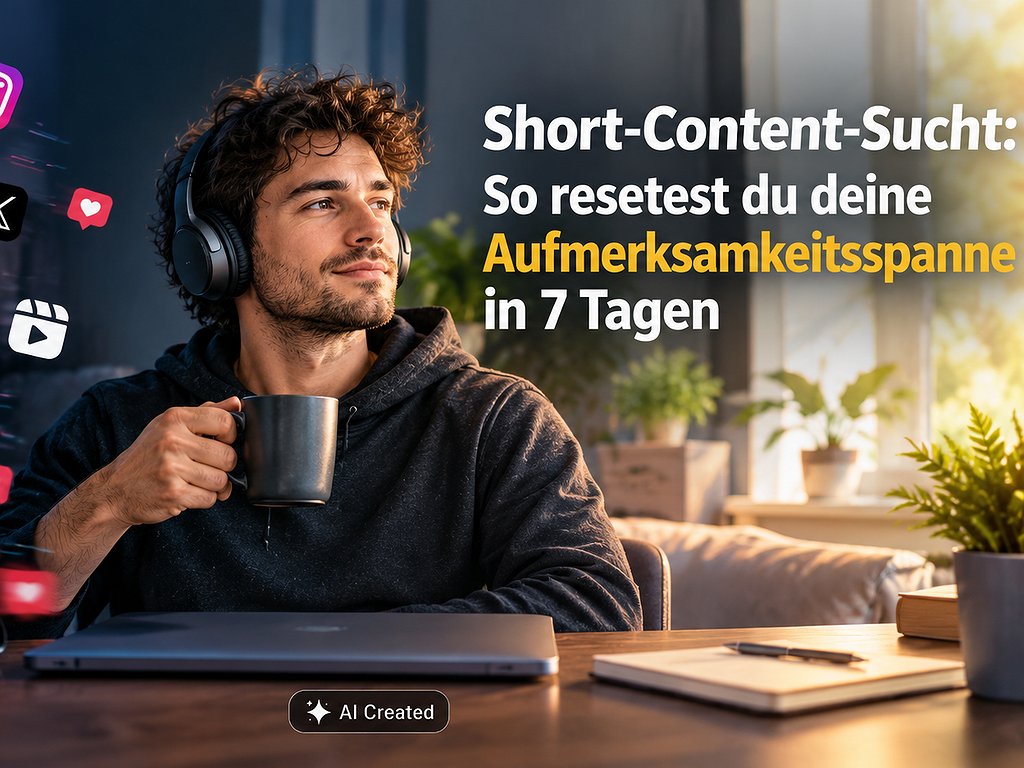
Short-Content Addiction: How to Reset Your Attention Span in 7 Days
You sit at your desk, want to write an email – and reach for your phone before your brain has even voted. Four minutes are gone. Then six. The task hasn’t become harder. You haven’t become lazier. But the threshold in your brain for “this is worth paying attention to” has been raised by years of faster, cheaper stimulation. And now a blank document, a real conversation, a boring Tuesday afternoon feels unbearably flat by comparison.
This is not imagination. The average attention span for a single screen has shortened over 20 years from 2.5 minutes to 47 seconds. A large study with over 8,000 children showed: social media – not TV or computer games – is the factor that worsens attention over time.
The good news: Your brain can recover. With a structured 7-day reset you can retrain your attention span – without completely giving up digital media.
1. What Short Content Does to Your Brain
TikTok, Reels and Shorts aren’t gripping by accident. They are designed to keep you on the platform as long as possible. Infinite scrolling, algorithmic recommendations, variable rewards – these are design techniques that originate in the gambling industry.
A central concept is “scroll immersion”: a state in which you dive so deeply into the feed that scrolling continues involuntarily. Time perception fades, and voluntary control diminishes.
The consequences:
- Attention residue: Every switch between contents costs cognitive resources. With rapid scrolling your brain constantly has to switch – this reduces efficiency by up to 40 percent.
- Impaired memory performance: A controlled study showed: after TikTok use the ability to remember intended actions fell to chance levels. Twitter and YouTube did not have this effect – the problem is specific to the short video format.
- “Brain fog”: Neurologists describe a state of cognitive exhaustion in which clear thoughts feel blocked as if by fog. Not a medical diagnosis – but a real feeling that arises from constant rapid stimulation.
2. The 7-Day Reset – Step by Step
The reset is based on one principle: reduce stimuli, actively retrain attention. Important: this isn’t about total abstinence, but about conscious control.
Day 1–2: Build awareness
What you do:
- Disable all non-essential notifications on your smartphone.
- Measure your current screen time – especially time in short-video apps.
- Observe: When do you automatically reach for your phone? What triggers it (boredom, stress, waiting)?
Why it works: The first step is not behavior change, but self-awareness. You can only change what you consciously perceive.
Day 3–4: Reduce and allow boredom
What you do:
- Reduce your short-video time by 25 percent.
- Go for a 20-minute walk – without your phone, without headphones.
- Allow yourself to be bored. Wait for the elevator without reaching for your phone. Sit in a café without scrolling.
Why this works: Boredom is the gym for your concentration. Your brain needs to learn to handle low stimulation without immediately reaching for the next hit.
Day 5–6: Train your focus
What you do:
- Read 15 minutes straight in a book – without interruption.
- Use the Pomodoro technique: 20–25 minutes of focused work, 5 minutes break.
- Start with realistic goals. If 20 minutes is too much, begin with 10.
Why this works: Like a muscle, your attention needs progressive loading. Every focused minute builds capacity.
Day 7: Integration and evaluation
What you do:
- A morning without TikTok, Reels or Shorts.
- Evaluate honestly: How does your focus feel now? What has changed?
- Plan which habits you want to keep.
3. Long-term strategies – what comes after Day 7
The reset is the beginning, not the end. These practices help you protect your attention long-term:
Consciously include analog activities
Replace passive consumption habits with active, analog activities. Reading a physical book, handwritten to-do lists, a puzzle or Lego – anything that promotes monotasking and enables flow.
Monotasking instead of multitasking
Multitasking is linked to memory loss. Doing one thing at a time reduces stress and builds focus. Start with 15 minutes of intentional single-tasking – reading, walking, eating, without doing something else at the same time.
Prioritize sleep
Sleep deprivation significantly reduces impulse control. 7–9 hours of sleep, no screens before bed and no short videos in bed are not optional extras – they are the foundation for attention.
Time in nature
Nature is a natural place for monotasking and flow. Even a short stay can help reduce attention fatigue and restore concentration.
Practice block: Your 7-day reset at a glance
| Day | Focus | Concrete task |
|---|---|---|
| 1–2 | Awareness | Turn off notifications, measure screen time |
| 3–4 | Reduce & boredom | 25% less short video, 20 min walk without phone |
| 5–6 | Train focus | 15 min reading straight, Pomodoro technique |
| 7 | Integration | Morning without Shorts, evaluation, planning |
Important: Concentration problems are not always related to media use. Lack of sleep, anxiety, chronic stress, ADHD, or depression can cause similar symptoms. If the problems seriously affect your life, seek professional help – rather than relying solely on a "dopamine detox".
4. Conclusion: Regain control, don’t demonize technology
TikTok, Reels and Shorts are not "evil." The issue lies in a brain that is constantly pulled into a loop of rapid stimulation – making long-term, valuable activities more difficult.
The good news: The brain is highly adaptable. By reducing stimuli, getting enough sleep, exercising regularly and scheduling deliberate focus times, many people can notice a difference within a few weeks.
In an age where attention is competed for, the ability to focus may be the most valuable skill you need to protect. The 7-day reset is your first step.
FAQ: Common questions about attention span and short-form content
Does TikTok really shorten my attention span?
Research shows a correlation: children who spend a lot of time on social media develop more inattention symptoms over time. The effect on an individual level is small, but it can be meaningful at the population level.
What is "scroll immersion"?
A state in which you are so absorbed in the feed that scrolling continues involuntarily. The sense of time fades and volitional control wanes – a central feature of problematic short-video use.
How long does it take for my attention span to recover?
Many people notice a difference within a few weeks. The 7-day reset is a structured start, but lasting change requires longer-term habit adjustments.
Do I have to delete TikTok completely?
No. Immediately deleting all apps is often hard to maintain. More effective is a gradual reduction – for example to 30–60 minutes per day – combined with deliberate breaks.
What is the difference between short videos and long videos for my brain?
One study showed: after TikTok use, recall fell to chance level, while Twitter and YouTube had no measurable effect. The problem is specific to the short-video format with its fast, unpredictable sequence.

Guter Punkt mit der Studie zu Kindern, würde mich interessieren welche Studien genau gemeint sind und ob da Kontrollgruppen berücksichtigt wurden 🤔
Hab das gemeint, zwei kontrollierte Längsschnittstudien aus 2018 und 2021, beide mit Kontrollgruppen, Link dazu im Kommentar unter dem Artikel, ansonsten hilft Google Scholar zum schnellen Nachschlagen 😊